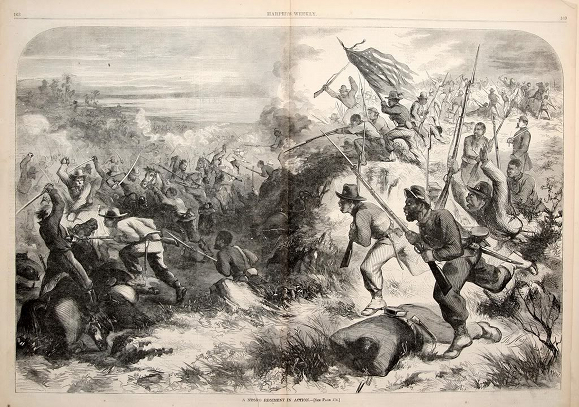
Harper’s Weekly was the most widely read magazine of the Civil War. It both shaped and reflected public opinion, as can be seen by the editorial “double-dealing” in the paper's treatment of African-American soldiers. Some entrenched racial stereotypes are indulged, such as the description of blacks as “docile” or their portrayal as animal-like (“Negroes as Soldiers” column), while simultaneously the same stereotypes are exposed as false: such as in the descriptions and illustrations of black soldiers’ conduct in combat (the cover and double-page image, and the “Negroes as Soldiers” column), or when the picture of a neat, dignified-looking African-American soldier (“Union Jim”/”Jim Williams”) is shown on the same page as a scraggly, duty-shirking, con-artist white soldier. (“A Straggler”).
The articles and illustrations shown here all appeared in issues of Harper’s Weekly from March 1863 (held in the Littlejohn Collection), when, after the Emancipation Proclamation of 1 January 1863, the Union was just beginning to (legally) field and pay African-American combat units — though the American "Colored Troops" were paid three dollars less per month.
The cover of Harper's Weekly, 14 March 1863
David Oyelowo portrays a Union corporal in Spielberg’s Lincoln (2012)
"Negroes as soldiers," Harper's Weekly, 14 March 1863
Calvin Candie, a plantation owner portrayed by Leonardo DiCaprio in Tarantino’s Django Unchained (2012), lectures his guests on phrenology, a pseudoscience disingenuously used by white supremacists of the time to “prove” the inferiority of sundry non-white peoples.
African-American troops depicted in combat, Harper's Weekly, 14 March 1863
Part of a page from Harper's Weekly 28 March 1863 in which "Union Jim" and "A Straggler" are portrayed
(This is a web exhibit reflecting historical materials from the Littlejohn Collection on display in the lobby of the Sandor Teszler Library until 29 March 2013.)
On May 14, 2011, the U.S. Army Corps of Engineers opened the Morganza Spillway in an attempt to ease flooding along the Mississippi River in Louisiana. The decision was made to protect the heavily populated areas and infrastructure around the ports of Baton Rouge and New Orleans. The decision is not without cost, however, to the thousands of people who are likely to lose homes and farms within the flood plain downstream.
On May 15, the Advanced Land Imager (ALI) on NASA’s Earth Observing-1 (EO-1) satellite captured this natural-color image (top) of the Morganza Floodway. The image was acquired at 11:20 a.m. Central Daylight Time, one day after the spillway was partially opened. The lower photo was taken on May 14 by the Army Corps, several hours after water began streaming onto the floodway.
The Library of Congress recently launched a new version of their Prints and Photographs Online Catalog, which includes some great new features. First, you might be wondering what the Prints and Photographs Online Catalog is. The catalog includes 1.25 million images from the Library of Congress's collection of ~14 million photographs prints, drawings, posters, architectural and engineering drawings, etc. "While international in scope, the collections are particularly rich in materials produced in, or documenting the history of, the United States and the lives, interests and achievements of the American people." (see About PPOC for more information)
The new features include better browsing and viewing options, as well as tools for sharing individual images, collections, or searches. For details about the new features, see the LOC's official announcement.
Down here in Spartanburg we are lucky to be able to observe a large variety of winged beasties. But North America itself is a very rich bird habitat - as the blooms come out, you'll hear the spring soundtrack of birdsong (and bird-shrieks!). With the help of my colleague Tim Brown I've assembled a few good resources for learning more about birds, their songs, their habitats, and their behavior.
Scholarly resources (search our catalog for these titles):
The Cambridge Encyclopedia of Ornithology (hard copy only).
Journal of Ornithology (electronic journal).
The Wilson Journal of Ornithology (electronic journal).
The Journal of Caribbean Ornithology (electronic journal).
Journal of Avian Biology (electronic journal).
And there are several more. Search in our catalog for "ornithology."
Or maybe a book about the history of ornithology? Try searching our catalog for "A passion for birds : American ornithology after Audubon." Just a hint.
You may also want to search our catalog using terms like "birds," "bird watching," and so on. Use the links (just about any blue text, really) in the catalog to refine your searches. Go ahead and fiddle with the "facets" on the right side of the results page to find different types of resources - not to brag, but we've got lots.
But you ask: How about an 1893 illustration of the Red-Tailed Hawk in the Public Domain that I can download? Funny you should mention....
Or perhaps over 350,000 digital images of birds assembled by the masses? Done:
Chirp, chirp and gobble, gobble - thanks to Tim B. for helping with this post.
The works in this collection may be used for free. According to the source, they are believed to be in the public domain. Please note, however, that while some photos are unrestricted, others may require attribution. The general rule: identify the photographer, physical location of the photo, and any other pertinent information regarding rights.