7.11.2013

"Physical Map of Palestine and the adjacent countries"


"Physical Map of Palestine and the adjacent countries"
Originally uploaded by Special Collections at Wofford College

A finely-detailed, hand-colored, fold-out map from John Kitto’s The Land of Promise, “a topographical description of the principal places in Palestine, and of the country eastward of Jordan, embracing the researches of the most recent travellers.” Published in London, c. 1852.

Full description

6.18.2013

Snapshots from a turn-of-the-century vacation

The two photographs below are from a photo album likely compiled by Walter M. Smith, an engineer with family ties to Spartanburg. According to the title page of the album, Mr. Smith appears to have a taken a tour of the eastern seaboard in the winter of 1901-02, during which these photographs were taken.

Title page of the photo album.


Stopping in Glenn Springs in eastern Spartanburg County, Mr. Smith took several photographs of scenes and buildings, including the two below. Shown from two different angles is the house of Dr. William F. Smith, described by a contemporary* as “well educated and a finished gentleman.” In the details, we can glimpse Dr. Smith on the porch of his home holding a toddler.


Two photos of the Dr. William F. Smith home as they appear in Walter Smith's photo album.

The photo on the left enlarged and enhanced.
A detail of that image showing children in the yard and others near the porch.

Dr. Smith's house from a different angle.

Detailed view of image above showing Dr. Smith with a toddler on his knee.

The album, from the Walter M. and Marie Smith Papers in the Littlejohn Collection, contains several dozen silver gelatin snapshots taken in Glenn Springs, Spartanburg, Charleston, New York, and Boston.


*Dr. J.B.O. Landrum, in his History of Spartanburg County (1900).

4.26.2013

Congratulations to Nikky Finney!


The Sandor Teszler Library congratulates Nikky Finney on her induction into the South Carolina Academy of Authors.

Author Nikky Finney next to an excerpt of her poem "The Thinking Men" on permanent display in Wofford's Old Main building, 2008.

Finney’s 2008 poem “The Thinking Men” celebrates the builders of Wofford’s Old Main.


Click image for larger size.

Finney is the author of several books of poetry and prose, editor of another, and, after 20 years of teaching at the University of Kentucky, will begin in the Fall of 2013 her tenure as the John H. Bennett, Jr. Chair of Creative Writing and Southern Literature at the University of South Carolina (Columbia).

For a biography and full list of publications, visit Finney's website.


4.09.2013

Permelia


This item is a receipt for the sale of 21-year-old Permelia to A.M. Holland by John Susan[?] for $1100. 

Receipt for sale of Permelia, an African-American slave woman

The full text reads:
“Rec’d of A.M. Holland Eleven Hundred Dollars for a Negro Woman Named Permelia which Girl I warrant sound in body and mind and free from all incumberances [sic]
Jany 24/59 –
[signed] John Susan[?]
Said Girl is about Twenty one years of age”
It is difficult to know much for certain about the people concerned in this transaction. The illegibility of the seller’s signature, perhaps due to his semi-literacy, prevents us from knowing his name for certain.

However, research reveals that an Adolphus Milton (A.M.) Holland (b. Georgia) married a Mississippi woman in 1858 in Harrison County, Texas and was living with her in Rusk County by 1860.


Knowing this, from a social and economic standpoint the purchase of a slave woman for domestic duties makes some sense and lends weight to the assertion that this was the same A.M. Holland.
It seems that A.M. Holland served as a Confederate soldier through at least 1863, until he was presumably disabled.
The fate of 21-year-old Permelia, though, is lost to history — for now. If she survived the war period, Permelia would have been about 27 years old by 1865, and may turn up in the 1870 Federal Census.


(This is a web essay reflecting an item from the Littlejohn Collection on display in the lobby of the Sandor Teszler Library until 22 April 2013.)


3.19.2013

The Big News of March 1863: African-Americans fight for the Union


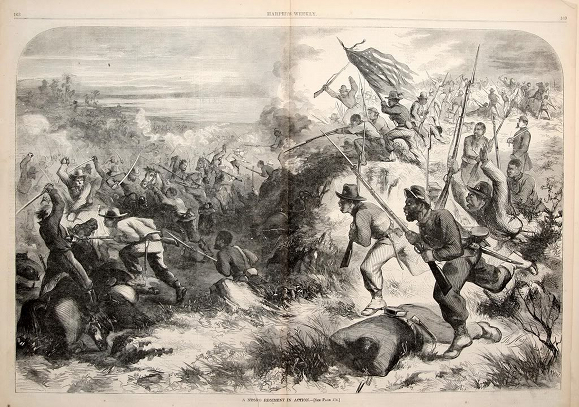
Harper’s Weekly was the most widely read magazine of the Civil War. It both shaped and reflected public opinion, as can be seen by the editorial “double-dealing” in the paper's treatment of African-American soldiers. Some entrenched racial stereotypes are indulged, such as the description of blacks as “docile” or their portrayal as animal-like (“Negroes as Soldiers” column), while simultaneously the same stereotypes are exposed as false: such as in the descriptions and illustrations of black soldiers’ conduct in combat (the cover and double-page image, and the “Negroes as Soldiers” column), or when the picture of a neat, dignified-looking African-American soldier (“Union Jim”/”Jim Williams”) is shown on the same page as a scraggly, duty-shirking, con-artist white soldier. (“A Straggler”).

The articles and illustrations shown here all appeared in issues of Harper’s Weekly from March 1863 (held in the Littlejohn Collection), when, after the Emancipation Proclamation of 1 January 1863, the Union was just beginning to (legally) field and pay African-American combat units — though the American "Colored Troops" were paid three dollars less per month.


The cover of Harper's Weekly, 14 March 1863 


 David Oyelowo portrays a Union corporal in Spielberg’s Lincoln (2012)

"Negroes as soldiers," Harper's Weekly, 14 March 1863


Calvin Candie, a plantation owner portrayed by Leonardo DiCaprio in Tarantino’s Django Unchained (2012), lectures his guests on phrenology, a pseudoscience disingenuously used by white supremacists of the time to “prove” the inferiority of sundry non-white peoples.


African-American troops depicted in combat, Harper's Weekly, 14 March 1863
Part of a page from Harper's Weekly 28 March 1863 in which "Union Jim" and "A Straggler" are portrayed


(This is a web exhibit reflecting historical materials from the Littlejohn Collection on display in the lobby of the Sandor Teszler Library until 29 March 2013.) 


11.28.2012

Maud Mary Mason, “Iris”


Works in the College’s art collection are housed in the Library when not on display in the galleries or campus building.  At times pieces move from one location to another for longer-term loans.

Recently a large still life painting of irises by Maud Mary Mason was transferred to the Kilgore-Clinkscales House on campus, the home of the Dean of the College.

The painting has been in the college collection for many years.  A photograph of long time college librarian Miss Mary Sydnor DuPré shows the painting behind her in the old Whitefoord Smith Library.  Miss DuPré was librarian from 1905-1953.  An undated note on the reverse of the painting itself also confirms the history:  “This painting, ‘Iris’ by Maud M. Mason, A.N.A. was given to Wofford College at the request of Grace Annette DuPré.  For many years, Miss Mason was considered to be the finest painter of flowers in the U.S.A.”

Maud Mason (1867-1956) indeed was well known in her time.  Born in KY, she moved early to New York City where she studied under Impressionists Charles Merritt Chase and Arthur Wesley Dow, as well as at the Art Students League and the Pratt Institute.

First known as a ceramist and ceramics teacher she also exhibited her paintings widely.  She reports to have begun doing floral paintings out of boredom:

"One day I just go bored while working from a model in Mr. Chase's studio, so I went out and bought a bunch of daffodils and painted them.  Mr. Chase liked the painting, and so did everyone else, and later I showed flower paintings at the National Academy of Design which were admired very much.  Orders for flower paintings began to come in, and I have never had time to paint much of anything else". [AskART]

11.20.2012

So, What’s an Archives?

[This column ran in the November issue of the South Carolina United Methodist Advocate.]

Archives conjure up all sorts of image, and in the popular imagination, they usually involve dust.

You probably are thinking of scenes from a movie, maybe an Indiana Jones film where he dashes into a room with lots of shelves and old volumes in search of some bit of information, some item of lost knowledge. Or maybe you’re thinking of a warehouse of boxes, or a small, dark room with someone, probably of advanced age, there to help find some hard to locate bit of information.
The truth is, we don’t really like dust, and we try to keep the books and papers in the various collections as free of it as possible. Archives vary in size, from closet to warehouse. And the types of things in archives aren’t limited to books, but can range from paper files to audio recordings and video tape, from maps to computer files, and from yearbooks to photographs.
Technically, archives are the permanently valuable records of an organization, such as a college, a church, a state, or an annual conference. In our case, they include such things as the conference journals, the Advocate, conference board and commission minutes, agency files, and district records. An archives might also collect materials that relate to its mission, such as books by and about South Carolina Methodism or Methodists, pictorial directories, local church histories, and files on different churches. Taking a broader view, archives to some people are simply the place where the old stuff goes, or where one goes for information about the past.
Our primary focus is on the records of the Annual Conference, though we do have the records of some closed local churches. If you are looking for local church history, the best place to start is in the local church or in the community, though we may be able to help with some statistics, a list of pastoral appointments, and changes in charge lines. We’ve been trying to put pictures of clergy online so that local churches can download them. 

Some researchers call to ask if we can produce an ancestor’s baptism or marriage record,
and anticipate that all of those records are on the internet, ready to be found with a quick Google search. I wish it were that easy. We don’t have the baptism or marriage records for active congregations, nor do we have their church council minutes. If we tried to keep all of that, we would need a warehouse, and anyone who has visited knows we don’t have that kind of space!

Why should your church have an archives? In part, because keeping local church history is the local church’s responsibility. That’s why you have a local church historian and a committee on records and history. The church historian’s job is to take care of the church’s historical records and to make sure that records being produced today – everything from the weekly bulletin or newsletter to the minutes of the church council – are being kept in a safe place.

You can find some help for these tasks on ourwebsite: http://www.wofford.edu/library/archives/methodist.aspx. There are links to the collections here in the archives and to resources that will help your church organize its own records. And you can always contact me for guidance. I’ll even remind you to keep the dust out.


WRITTEN BY: PHILLIP STONE - November 14, 2012


Where are all the Chi Phi brothers?


Would all of the alums who are members of Chi Phi please stand up.
Members of Chi Phi with Professor Henry Nelson Snyder, center,1896.
Silence.
Oh, that’s right, that fraternity hasn’t existed at Wofford for over 100 years.  What happened to it?
Chi Phi was the third fraternity to be established at Wofford, after Kappa Alpha and Chi Psi.  These first two got started in 1869, and the Chi Phis were chartered in 1871.  Over its forty years at Wofford, the Sigma chapter initiated a number of students who went on to become prominent in the community.  A short list of those would include Howard B. Carlisle ‘1885, James A. Chapman ‘1883, a noted textile leader, Dr. John G. Clinkscales ‘1876 of the Wofford faculty, Thomas Carey Duncan ‘1881, a noted textile leader, William Preston Few ‘1889, the first president of Duke University, W. Thornwell Haynes ‘1893, an American diplomat, and approximately 160 other alumni.
Though the number of active fraternity members was never especially large, the actions of some fraternity and anti-fraternity students caused the trustees to ban all of the Greek-letter organizations in 1906.  All of the fraternities had to surrender their charters, though many of them simply went underground.  After several years of agitation by students and alums, and after what really amounted to an ultimatum from a group of students, the faculty and trustees relented, and in the fall of 1915, fraternities were allowed back, subject to the rules of the college.
However, the national organization of Chi Phi declined to allow the chapter at Wofford to have its charter back.  President Snyder, himself a Chi Phi from Vanderbilt, worked his connections to try to get the fraternity back on campus, but to no avail.  He reported to one correspondent that the objections came from the northern chapters.
The Chi Phis left a few items behind for us to remember them by.  Among these are a few group photos, some alumni bulletins, and assorted fraternity pins.  The pin below, which belonged to James A. Chapman ‘1883, was recently donated to the library by his great-granddaughter, Mrs. Laura Chapman Jackson Hoy, who is now a member of the Wofford board of trustees.
Written by Phillip Stone, November 20, 2012
Chi Phi pin, 1883
Chi Phi pin, inscribed JAC, WC 83

8.08.2012

Poet Laureate of the Lost Cause


James Ryder Randall
On April 26, 1861, “My Maryland!” was published in the New Orleans Sunday Delta. James Ryder Randall (1839-1908) wrote the poem in response to the death of his friend Francis X Ward, who was one of the civilians killed during the riots that swept through Baltimore as federal troops marched to protect the capital.


My. Maryland!

The despot’s heel is on thy shore,
Maryland!
His torch is at thy temple door,
Maryland!
Avenge the patriotic gore
That flecked the streets of Baltimore,
Maryland! My Maryland!

~ ~ o ~ ~

Hark at an exiled son’s appeal,
Maryland!
For life and death, for woe and weal,
Thy peerless chivalry reveal,
And gird thy beauteous limbs with steel,
Maryland! My Maryland!
Thou wilt not cower in the dust,
Maryland!
Thy beaming sword shall never rust,
Maryland!
Remember Carroll’s sacred trust,
And all thy slumberers with the just,
Maryland! My Maryland!

~~ o ~~

Come, ‘tis the red dawn of the day,
Maryland!
Come with thy panoplied array,
Maryland!
With Ringgold’s spirit for the fray,
With Watson’s blood at Monterey,
With fearless Love and dashing May
Maryland! My Maryland!

~~ o ~~

Dear Mother! burst the tyrant chain,
Maryland!
She meets her sisters on the plain -
Sic Semper! ‘Tis the proud refrain
That baffles minions back amain
Maryland!
Arise, in majesty again,
Maryland! My Maryland!

~~ o ~~

Come, for thy shield is bright and strong,
Maryland!
Come, for thy dalliance does thee wrong,
Maryland!
Come to thine own heroic throng.
Stalking with Liberty along,
And chaunt thy dauntless slogan-song,
Maryland! My Maryland!
I see the blush upon thy cheek,
Maryland!
For thou wast ever bravely meek,
Maryland!
But lo! there surges forth a shriek,
From hill to hill, from creek to creek,
Potomac calls to Chesapeake,
Maryland! My Maryland!
Thou wilt not yield the Naudal toll,
Maryland!
Better the fire upon thee role,
Better the shot, the blade, the bowl,
Than crucifixion of the soul,
Maryland! My Maryland!

~~ o ~~

I hear the distant thunder -hum
Maryland!
The Old Line bugle, fife and drum,
Maryland!
She is not dead, nor deaf, nor dumb -
Huzza! She spurns the Northern scum!
She breathes! She burns! She’ll come! She’ll come!
Maryland! My Maryland!

Written at Pointe Coupee, La, 1861. by
James R. Randall

Two weeks before, on April 12 1861, the newly formed confederacy had bombarded Fort Sumter, starting the American Civil War. In response, President Abraham Lincoln ordered 75,000 troops from the northern states to assemble in Washington, D.C. to suppress the rebellion. Baltimore citizens were determined that Northern troops would not make it through their city. And they knew how to put up a fight. The magnificent city of the colonial period had fallen into the grips of thuggery and violence by the 1850s. In fact, Baltimore had such an unruly reputation that in February 1861 Abraham Lincoln went through the city in disguise in the middle of the night on his way to his inauguration.

So when a Massachusetts regiment marched through the city on the way to the capital, it was attacked by a mob, resulting in the first fatalities of the war. All Washington’s connections to the North normally went through Baltimore, but Baltimore citizens had burned all the railroad bridges, cut telephone wires, and stopped all mail en route to the capital city. Cut off from the north and surrounded by a sea of southern states, Washington was left vulnerable for six days. Across the Potomac, southern troops prepared for an attack, and Maryland was threatening to secede at any moment. Maryland straddled the north and the south and both sides fought to win over its population throughout the Civil War. The state never seceded, but around 30,000 citizens enlisted in the Confederate army.

“My Maryland!” serves as Randall’s plea to his home state to secede from the Union and join the Confederacy. The poem refers to the Revolutionary and Mexican-American wars and Maryland military heroes (most of which are now obscure).  Randall was a poet, journalist, and professor at Poydras College in Pointe Coupee, Louisiana, and “My Maryland!” won him the title “Poet Laureate of the Lost Cause.” Jennie Carrie set the poem to the tune of “Lauriger Horatius” (O'Tannenbaum), and it became popular across Maryland and the South. CSA bands played the song after they crossed into Maryland during the Maryland Campaign of 1862. Robert E. Lee reportedly ordered troops to sing the song as they entered Frederick, Maryland, where the caroling soldiers were met with a cold audience of Unionists. At least one CSA regimental band played the song as Lee’s troops retreated across the Potomac after the Battle of Antietam.

“My Maryland!” was adopted as the official state song of Maryland on April 29, 1939. Since then, citizens of Maryland have occasionally attempted to replace the song because of the its history with the Confederacy and the fact that the lyrics refer to Lincoln as a “tyrant,” “despot,” and “vandal” and the Union as “Northern scum.” “My Maryland!” remains the official state song.


--Hannah Jarrett '12


Works consulted:
Frank B. Marcotte, Six Days in April: Lincoln and the Union in Peril, New York: Algora Pub., 2005.

http://www.msa.md.gov/msa/mdmanual/01glance/html/symbols/song.html

8.03.2012

“The Shut Up Shelves:” Librarians as Censors in 1908

Librarians today are known as crusaders for intellectual freedom, dedicated to providing unhindered access to a wide variety of content. Their dedication was shown most dramatically in 2003, after the Patriot Act made it permissible for the FBI to request library records on patrons’ reading habits, computer use, and more. Librarians began shredding patron records so that, if faced with a request from the FBI, they would be unable to comply.1 They understood that protecting intellectual freedom isn’t just about putting books representing a wide spectrum of perspectives on the shelves, but also protecting patrons’ privacy and allowing controversial books to be just as accessible as any others.

However, in late 19th- and early 20th-century America, protecting readers from “bad books” was seen as an important part of a public librarian’s job. Depending on the community and librarian, a “bad book” could be anything from a literary classic with sexual content, a novel by an author with a controversial moral or political perspective, a book on sexual health, or an illustrated anatomy textbook. “Exclusion” of unsuitable books, as it was called, was not a job that all librarians relished, but it was a duty they took seriously. In a 1908 piece in The Library Journal, librarians from around the country described their procedures regarding the exclusion or restriction of controversial material. A librarian at the Brooklyn Public Library explained, “here and there is found an ‘indignant citizen’ who questions the right of the library authorities to act as censors, but the reading public and the taxpayers expect such a course, and consider it the proper one to pursue when looked at from the standpoint of what books are likely to be best appreciated by readers.”2


powered by Fotopedia

  
Most of the librarians who contributed to the 1908 piece agreed that books that were clearly “immoral or indecent” would simply not be bought by the library, and one noted that “every library exercises a certain amount of censorship of a negative kind when it is forced by the meagerness of its funds to purchase only a limited number of the new books published.”3 However, when such books had literary merit or academic value, the solution was not so simple. Books by foreign authors were frequent targets of exclusion, and some librarians reported only purchasing them in their original languages to limit readership. As they do today, children’s sections steered young readers to age-appropriate materials, but this did not address the issue of adults accessing these materials without guidance. Wisconsin librarian, Mary Frances Isom, explained that in her library:

all these [questionable books] are kept under lock and key in the librarian’s office and marked with a ‘Minor label’ plate [a label stating that it was not suitable for young readers]. The catalog cards show no location and the small collection is held in mind without difficulty by the assistant. The young people seldom discover the existence of this forbidden fruit…A few library-wise women with morbid tastes yearn for a sight of ‘the shut up shelves,’ but in vain, for no one is allowed to go to these shelves; books must be requested from the catalog. They are read consequently only by those who know what they are asking for.4

Other librarians described similar systems. In some libraries, a patron requesting books from hidden shelves would have to answer questions to prove that his or her interest in the material was scholarly. At the Pratt Institute Free Library in Brooklyn, New York, patrons who requested a book bearing a warning label were asked by the librarian to read the label and confirm that he or she understood and still wanted the book. These hurdles may have deterred immature readers from books librarians thought would disturb or negatively influence them, but they also deterred adult patrons with genuine literary or scholarly interest. Many were likely unwilling to run the risk of being judged as morally or politically deviant, or invite scrutiny of their personal lives based on their reading interests. 

The librarians’ 1908 accounts show a profession held responsible for the intellectual diets of their patrons, under great pressure to protect readers, especially the more impressionable, from potentially disturbing or unsavory material. Today, the public’s expectation of librarians is very different, and while children’s and teen sections guide young people towards books that are appropriate and engaging for their age levels, public libraries have dispensed with the complex systems of restriction that once “protected readers” at the cost of intellectual freedom.

--Jennifer Coggins '12

Sources:
1. Dean E. Murphy, “Librarians Use Shredder to Show Opposition to New FBI Powers,” New York Times, April 7, 2003.
NYT
2.“What Shall Libraries Do About Bad Books? II” The Library Journal  (October 1908): 390. Google Books
3. “What Shall Libraries Do About Bad Books?” The Library Journal  (September 1908): 353. Google Books
4. Ibid.

Related Reading:
Christopher M. Finan, From the Palmer Raids to
the Patriot Act (Boston: Beacon Press, 2007).

Arthur E. Bostwick, “The Librarian as a Censor: Address of the President, American Library Association, Lake 
Minnetonka Conference, 1908” The Library Journal, July 1908, p.257. Google Books

Frederick J. Stielow, “Censorship in the Early Professionalization of American Libraries, 1876 to 1929,” The Journal of Library History 18.1 (Winter 1983). JSTOR