Showing posts with label manuscripts. Show all posts

8.01.2012

The Other Adams Woman: Louisa Catherine Adams

Despite her husband’s inevitable protest, Louisa Catherine Johnson Adams applied rouge to her cheeks in their Berlin apartment.  She rehearsed her defense as she admired herself in the mirror.  

“Do you want me to look a fright in the midst of Splendour?” she whispered, imagining John Quincy standing in front of her with a disapproving look.1
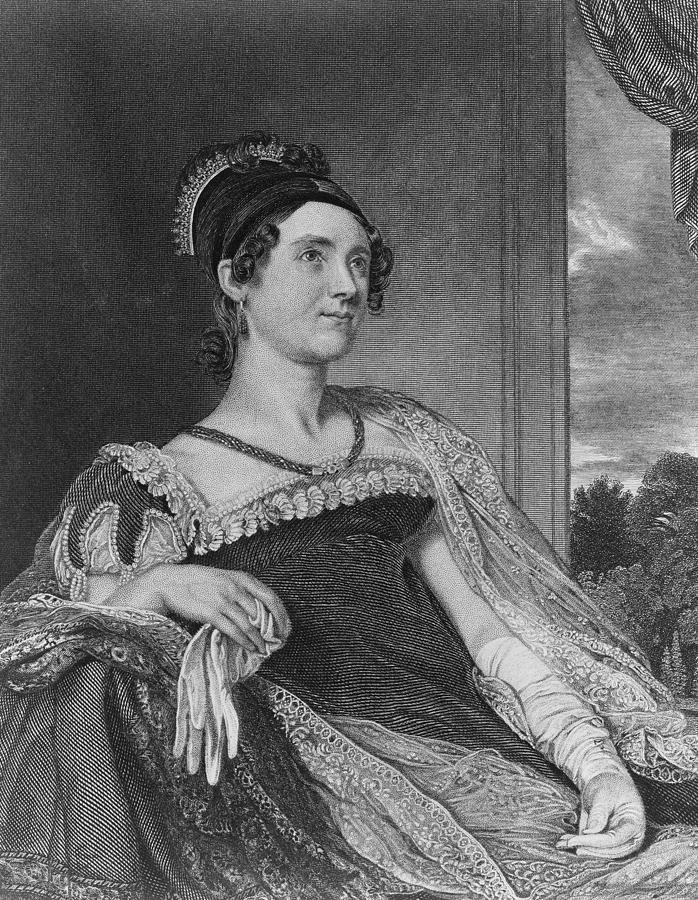
This portrait of Louisa Adams was painted by Charles Robert Leslie in 1816 in London. 

The night before, when the Prussian Queen had offered her the rouge, John Quincy had insisted that she refuse.  At first, Louisa had dutifully done as he commanded.  She began to have second thoughts, though, when saw her reflection in a darkened window.  Her face was rather pale.   While John Quincy was occupied, she sought out the Queen and accepted her offer.  After some convincing, she knew her husband would understand.  She was, after all, the wife of the Ambassador to Prussia and the daughter-in-law of the President of the United States, and rouged cheeks were expected of her in Berlin’s court society.

Louisa stood up, checking herself one last time in the mirror.  No one could deny that her brightened face livened her dull homemade dress.  John Quincy walked into the room, and Louisa reached up to dim the light in an attempt to hide her face.  Just as she thought she had escaped his notice, John Quincy pulled her close to the light.  She saw the rage in his eyes as he demanded that she wash her face.  But instead of complying, Louisa “with some temper refused.”2 In a surge of anger, John Quincy left for the party without her.  But Louisa didn’t let that discourage her.  With her face still decorated, she arrived at the party on her own and ended up making quite an impression on the king and queen of Prussia.  

If Louisa ever regretted defying her husband, she never let it show.  Based on her parents’ relationship, she believed “it was necessary for her own self-respect...to remind her husband from time to time that she was not the conventionally submissive helpmeet that middle-class Americans seemed to admire in their wives in the early nineteenth century.”3

Louisa’s childhood had been filled with encouragement and opportunity, which turned out to be both her blessing and her curse.  Born in London in 1775 to an American father and an English mother, Louisa attended school in France, where she became so fluent in French that she had to relearn English when she returned to London.  Since French was the language of diplomatic society at the time, Louisa was able to hold her own in the courts of Europe even though John Quincy would have preferred to control his wife’s tongue as much as possible.4  

Louisa and John Quincy met and married in London in 1797.  They were an unlikely pair from the start; everyone suspected that John Quincy would marry one of Louisa’s older sisters.  Louisa, who “foresaw women taking a vigorous role, one of equal importance to that of men”5 was not the most obvious choice for a man like John Quincy, who, with his short temper and severity, was determined to bow to no woman.  

Like many men during his time, John Quincy would tolerate only the most passive female, which would seem unlikely considering the relationship between his parents.  With a mother like Abigail Adams, it would only seem logical for John Quincy to marry a woman like Louisa.  But John and Abigail Adams had reservations about the Johnson-Adams marriage.  In fact, Abigail thoroughly disapproved of her son’s wife at first, mostly because she judged Louisa as a foreigner and “anti-american.”  With their son’s political career in mind, “they often fretted about [Louisa’s] ability...to measure up to the rigorous family standards.”6 Louisa eventually proved herself to her in-laws, and they welcomed her into their lives and hearts.

The same could not be said for John Quincy.  As his parents grew more fond of Louisa, he grew more distant.  Time would prove that John Quincy “never saw in marriage the partnership arrangement advocated by his parents....At heart he seemed to fear the opposite sex, and eventually most of his anxiety took the form of disregarding and disobeying his wife.”7

But the couple’s dysfunctionality was not the only thing to plague their marriage.  Louisa had twelve pregnancies and seven miscarriages between her twenty-first and forty-second years, and as a result, “her health was wretched a great deal of the time....She once complained that ‘hanging and marriage were strongly assimilated.’”8

Despite everything, Louisa supported her husband’s political endeavors.  In 1824, John Quincy refused to campaign for the presidential nomination.  He expected to be nominated as “a reward for his many years of public service.”9  As a result, Louisa became his campaign manager.  Louisa “curried to the right congressional wives, always ‘Smilin’ for the Presidency,’ calling cards in purse.... In the election year, she hosted dinners for sixty-eight congressmen.  Every single Tuesday night between December and May, she held open house with fine wine, lavish food, and musical entertainment.”10  No doubt that John Quincy was fully aware of what his wife was doing for him, and we can only hope that he realized that without her he had little chance of being elected.11

If Louisa could have seen the future, though, she might not have worked so hard to get her husband into office.  Her years as First Lady were the worst of her life.  She noted that “the exchange to a more elevated station must put me in prison.”  Furthermore, after he was elected president, John Quincy’s use for his wife ended. He became even more cold, demanding, and inconsiderate toward her, and once sniped, “There is something in the very nature of mental abilities which seems to be unbecoming in a female.”12

Louisa proved to be good at hiding her true feelings, though.  Harriet Upton, in an illustrated piece for the November 1888 issue of Wide Awake, described Louisa as “enjoying an existence of ‘wooings and weddings, baby life and christenings and many frolics, long old-fashioned visits from relatives, quiet hours when the President read aloud.” The article pictured a first lady who, like all right-minded women, served in a man’s world.”13  In truth, Louisa spent most of her time alone and ignored, and she called the White House “her prison” and a place “which depresses my spirits beyond expression.”14

Louisa spent most of her time in the White House alone in her room.  Over the years, she developed a deep depression and a breathing problem (her room was heated with burning anthracite coal, which caused choking and coughing).  Louisa wrote that her depression “passes for ill temper and suffering for unwillingness and I am decried an incumberance unless I am required for any special purpose for a show or some political maneuver and if I wish for a trifle of any kind, any favor is required at my hands, a deaf ear is turned to my request.  Arrangements are made and if I object I am informed it is too late and it is all a misunderstanding.”15

To combat her isolation and depression, Louisa ate chocolates obsessively and took to writing poems and satirical plays about the folly of society and the illnesses of females.  She also began her autobiography, which she called Adventures of a Nobody.16  In short, Louisa was angry.    She was angry about what she believed men were doing to humiliate women.17  A latent feminism emerged in her writing, which “was aroused in her bitterness over a world in which man controlled female, no matter how capable the female might be.”  Louisa resented “that sense of inferiority which by nature and by law we [women] are compelled to feel and to which we must submit is worn by us with as much satisfaction as the badge of slavery generally, and we love to be flattered out of our sense of degradation.”18

To Dr. Thomas.
___

at note last night addressed to you
was by my pen indited [sic]:
Professional alone ‘tis true
By anxious doubt incited:
Your presence eased the laboring? thought
The note aside was laid
Before, with kind expression fraught
my compliment was paid
In justice then Dear Doctor now
The pen I quick resume,
Esteem and friendship to avow,
To love I cann’t presence -
Love such as Mother to her Son
With bond affection proffer’d;
Sprung from a grateful heart alone
with pleasure may be offer’d -
of deep respect assurance kind
no proof what’ere requires
Tis the conviction of the mind
that merit aye inspires;
This silly scrawl you must excuse
A laugh its best reward
The Sentiment do not refuse;
The lines their just reward

Louisa Catherine Adams

F. Street 25 Jan 1842


Above: Louisa Catherine Adams' poetry manuscript dated 1842, from the Littlejohn Collection at Wofford College.Following his term as president, John Quincy entered Congress and became involved in the anti-slavery movement, which resulted, finally, in the couple developing a sympathetic understanding for each other.19  Louisa spent her last years dedicated to the fight for freedom of slaves and women.20 Their mutual pursuit for equality at the end of their lives was the closest thing to a happy ending the couple had.Years after her death, Louisa’s grandson, Henry Adams, remembered thinking there was something exotic about his grandmother.  He wrote that he liked “her gentle voice and manner; her vague effect of not belonging there [Boston], but to Washington or to Europe, like her furniture, and writing-desk with little glass doors above and little eighteenth-century volumes in old bindings labelled ‘Peregrine Pickle’ or ‘Tom Jones’ or ‘Hannah More.’  Try as she might the Madame could never be Bostonian, and it was her cross in life, but to the boy it was her charm.”  Henry Adams knew little about his grandmother’s interior life, which had been, like many women of the time, full of severe stress and little pure satisfaction.21
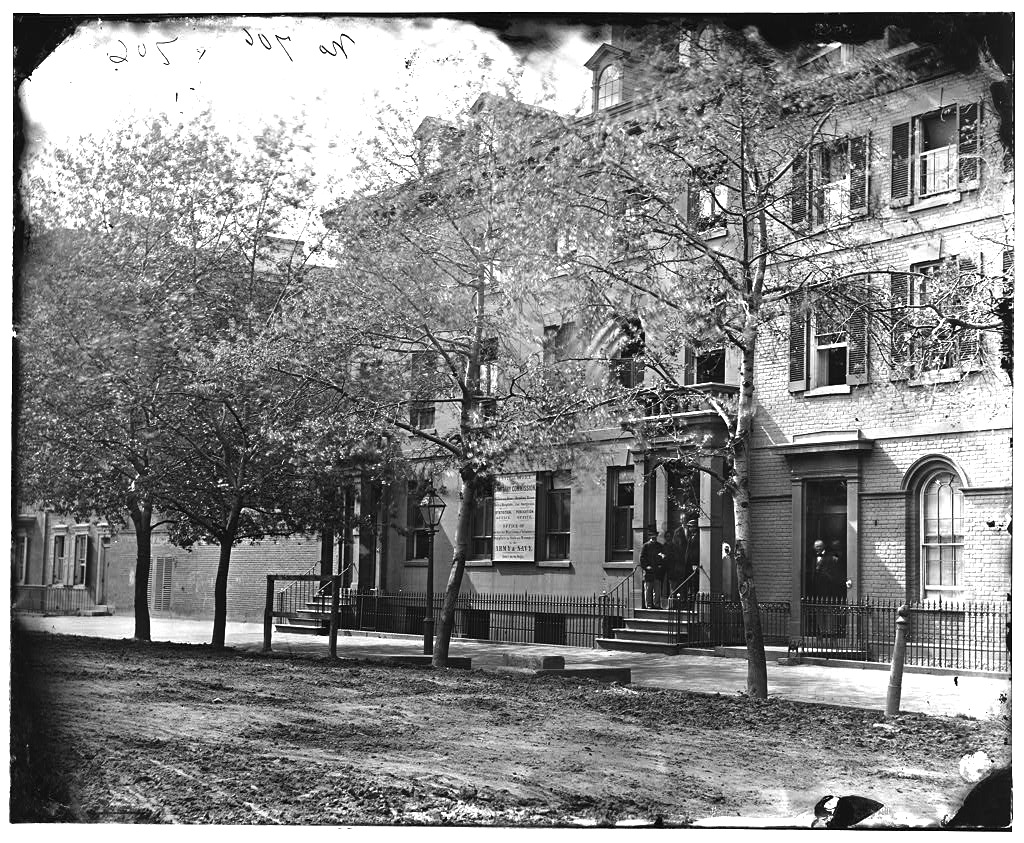

The F Street house near the White House was Louisa’s home during many of her years in Washington and the site of her death.  Earlier, it had been the residence of Dolley and James Madison.  The property remained in the Adams family until 1884.


-- Hannah Jarrett ‘12


1. Boller, Paul F. Jr., “Louisa Catherine Adams 1775-1852,” Presidential Wives: An Anecdotal History, New York: Oxford University Press, 1988, pp. 55.
2. Nagel, Paul C., The Adams Women: Abigail & Louisa Adams, Their Sisters and Daughters, New York: Oxford University Press, 1987, pp. 170.
3. Boller 56.
4. Allgor, Catherine, “Louisa Catherine Adams Campaigns for the Presidency,” Parlor Politics: In Which the Ladies of Washington Help Build a City and a Government, University Press of Virginia, 2000, pp. 161.
5. Nagel 161.
6. Allgor 161-162.
7. Nagel 164.
8. Boller 55.
9. Boller 57.
10. Anthony, Carl Sferrazza, First Ladies: The Saga of the President’s Wives and Their Power 1789-1961, New York: William Morrow and Company, Inc., 1990, pp. 107.
11. Boller 58.
12. Anthony 108.
13. Nagel 3.
14. Boller 53.
15. Anthony 108.
16. Anthony 109.
17. Nagel 4.
18. Anthony 109-110.
19. Boller 54.
20. Anthony 111.


21 Boller 60-61.

3.13.2012

CSA Patent Office and Rufus Randolph Rhodes

The Confederate States Patent Office began to take shape in the early months of 1861 after Jefferson Davis sent word to the Confederate Provisional Congress that the government was already receiving seventy patent applications a month. 1

Rufus Randolph Rhodes, who had experience in the U.S. Patent Office before secession, was appointed Commissioner of Patents, and he moved the patent records office from Alabama to Richmond, Virginia.2 The first Confederate patent was issued on August 1, 1861, and patents were issued regularly by the CSA Patent Office after that.3 The most famous invention patented by the CSA Patent Office was the Confederate ironclad ship Merrimac, which was designed by John Mercer Brooke.4

Patent - Confederate States of America (1 of 2)Patent - Confederate States of America (2 of 2)


Above: An 1862 patent for Azel S. Lyman’s Disintegrating Process signed by Rufus R. Rhodes, Commissioner of Patents. Held in the Littlejohn Collection at Wofford College.

Azel S. Lyman’s Disintegrating Process was used for preparing flax, hemp, and other fibrous plants for textile purposes. The invention was acclaimed for its “ingenious application of the explosive power of steam to the separation of the fibers of all vegetable materials.”

To the agriculturist it presents a powerful inducement for to profitable account the vast area of western specially adapted to the growth of flax and hemp while it furnishes facilities for utilizing the thousands of tons of flax straw which have been and still are left as useless to rot the ground after the removal of the seed.5

Patents are granted by the government to inventors for a certain period of time. To acquire a patent, inventors must go through a application process, which includes a petition and various fees. The invention is then reviewed by government appointed patent examiners before being approved for a patent. A patent allows the inventor to “exclude others from making, using, selling, or importing into the country the patented invention for a period of time.” Essentially, patents secure a way for inventors to make money from their inventions. Abraham Lincoln stated that the patent system “added the fuel of interest to the fire of genius, in the discovery and production of new and useful things.” 6

Yet the CSA Patent Office does not appear to have granted very many patents during its short existence. Between 1861 and 1864, the CSA Patent Office only issued 266 (known) patents, which is a small amount when compared to the 16,051 patents issued by the U.S. Patent Office during that same period. That is, the number of patents the south granted was less than 10% of the national total. Does that mean the South lacked inventive genius?

The lack of southern patenting compared to Northern patenting has been used to argue several things about the state of the south before, during, and after the Civil War: (1) the south was agrarian, and therefore less likely to support new inventions and patents; (2) the south was not as educated as the north in terms of technology; and (3) the south lacked mills and other industry that fostered invention. H. Jackson Knight eliminates these possibilities as major factors because they do not hold up against the reality of the South during the Civil War.7

Knight offers other possibilities for the lack of southern patenting: (1) there was a lack of foreign immigrants in the southern states before the war, as compared to in the northern states; (2) the practice of agriculture in the south was a rural enterprise, and there was less motivation to patent any inventions; (3) there was a lack of highly developed communication and transportation, which made sharing information about inventions more difficult; and (4) there was the war itself and the uncertainty of government protection of inventions.8

In the south, patents were a secondary objective unless the invention could be used to help defeat the enemy. In fact, in 1861, 32% of patents issued by the CSA Patent Office fell under the category “Fire Arms and Implements of War.” One third of the patents in 1862, the year of Lyman’s Disintegrating Process, were for inventions for use in the war. Only one patent in 1862 is recorded to be for the “Manufacture of Fibrous Substances, Including Machines,” which is the category Lyman’s invention would fall under. (Knight doesn’t mention Lyman in his book, so it is unknown if he is referring to Lyman’s invention here.) 9

There is perhaps a more practical reason for the lack of southern patents. Rhodes noted that patent applications dropped during the second half of 1862 because “occupation of considerable portions of the Confederate States by the Union Army” meant that the clerical force of the CSA Patent Office was reduced. In fact, by the end of the war, there was only one examiner in the CSA Patent Office.10

Also, it is important to keep in mind that the CSA Patent Office burned down in April 1865 after Confederate forces set fire to the city during the evacuation of Richmond. In June, the U.S. Commissioner of Patents sent an examiner to recover any records of the CSA Patent Office, but he didn’t find anything. The only known surviving records of the CSA Patent Office are two partial ledger books, a few original patents (such as the one for Lyman’s invention), four Annual Reports of the Confederate Commissioner of Patents, and various other printed reports. 11

-- Hannah Jarrett ‘12


CITATIONS

1. Kenneth W. Dobyns, The Patent Office Pony: A History of the Early Patent Office, http://www.myoutbox.net/popch27.htm, p. 167.

2. H. Jackson Knight, Confederate Invention: The Story of the Confederate States Patent Office and Its Inventors, Baton Rouge: Louisiana State University Press, 2011, p. 50.

3. Dobyns, p. 167.

4. Dobyns, p. 169.

5. The Friend, August 8, 1861.

6. Knight, p. 1.

7. Knight, pp. 73-74.

8. Knight, p. 90.

9. Knight, p. 122.

10. Dobyns, p. 168.

11. Dobyns, p. 169.

12.13.2011

A Confederate General looks back with a critical eye

While the Civil War did not propel General Lafayette McLaws to fame as it did his comrades Robert E. Lee and James Longstreet, the archival footprints of McLaws are deep. The letters and speeches that he wrote both during and after the Civil War are a treasure trove of first-hand accounts that provide an alternative to the much-celebrated “Lost Cause” perspective of the war. The Littlejohn Collection retains seven of these letters, dated from 1886 to 1889, a period when the retired McLaws was attempting to gain publicity through speech-making and the publication of his (sometimes controversial) articles. In these letters, addressed to Isaac Pennypacker of the Philadelphia Press, McLaws discusses events and people on which he is planning to write, glorifying some men and impugning others shamelessly. Through the mess of McLaws’ penmanship are revealed several interesting character evaluations that point to a critical problem within the ranks during the Civil War--division between officers.

The most common thread in McLaws’ letters is the criticism of officers, both Union and Confederate. However, three prominent instances of discord between officers are alluded to as potential game-changers. First, the disobedience of General William B. Franklin to General Ambrose Burnside during the Maryland Campaign caused, McLaws argues, the failure of the Union effort at Fredericksburg and Sharpsburg. Second, the ambition of General Daniel Sickles caused him to be wholly unreliable and even dangerous. And third, the enmity between General James Longstreet and McLaws is expounded by McLaws himself. McLaws is able to speak with confidence about each Sickles, Longstreet, and Franklin, because he fought either with or against them on numerous occasions during the war, and graduated from West Point with the two latter.


Pictured at left: William B. Franklin
At right: Ambrose Burnside


William Franklin: “Unsafe to Rely on in Great Enterprise”

McLaws fought Franklin in five battles: The Seven Days battles in June 1862, Harpers Ferry in September 1862, Antietam (or Sharpsburg, as McLaws refers to it) in September 1862, Fredericksburg in December 1862, and Chancellorsville in April 1863. Franklin graduated from West Point one year after McLaws, first in his class, and McLaws esteems Franklin as a “gentleman of great ability and of high character.”1 However, McLaws is critical of Franklin’s hesitancy, and on numerous occasions points out his inability to risk much in battle. Consequently, Franklin nearly always kept large numbers of his forces in reserve, when it was the policy of the Confederates to engage as many troops as possible, and at Harpers Ferry and Sharpsburg Franklin was overrun by forces that outnumbered his when success may have been possible had he engaged his reserve forces.

Generally, the historical perspective of General Burnside’s failure at Fredericksburg is attributed to Burnside himself. The 12,600 men that were lost on his watch at Marye’s Height tainted his reputation among his fellow generals, and even President Lincoln himself began to look into Burnside. 2 When Burnside complained to the Conduct of War Committee in February of 1863 that Franklin’s “lack of...strict adherence” 3 to his orders resulted in the Union defeat, Franklin refuted this claim, arguing that Burnside was trying to salvage his reputation through shameless scapegoating. In a reply to the War Committee of Congress in May, Franklin declared that he “will prove by documentary evidence from Gen. Burnside’s hand that his plan, as given to the Committee, was not the plan on which he conducted the operations of that battle.”4

Yet while historians tend to side with Franklin, McLaws disagrees. If Franklin had chosen to engage all of his troops instead of keeping some in reserve, he argues, Lee would have been forced to retreat. Franklin had 60,000 men in his command and was ordered by Burnside to launch an attack on “the high ground,” Prospect Hill, but sent only his smallest division, 4500 under the command of Meade, to fight the 7 active divisions of Jackson, who had 3 reserve divisions stationed behind. Burnside, who was engaged at Marye’s Height, learned that his left flank had not been taken by Franklin and ordered him to send in more troops, but Franklin did not, seeing the risk to be too large. Meade’s initial success was not reinforced and consequently the Union forces had to withdraw.

Burnside and Franklin each provided accounts of the strategies employed and orders given. Historians agree that Burnside’s orders were “vague” enough to confuse most generals, for which Franklin should not be blamed, and that if Franklin made a mistake, it was writing a letter to General William Smith complaining that Burnside was a poor leader and that Franklin’s own performance would have been better under a more competent general. 5 The letter, unfortunately, made its way to Burnside’s lap, and Burnside immediately began campaigning for Franklin’s reassignment. Despite McLaws’s claim that Franklin was at fault at Fredericksburg, the next year showed that Burnside had a penchant for delegating blame. In January of 1863, Burnside offered an ultimatum to President Lincoln: court-martial the generals who had been critical of his performance, or he’d resign. Lincoln accepted his resignation and, in Burnside’s place, promoted Joseph Hooker, his chief critic.


Left: Daniel Sickles
Right: George Meade


Daniel Sickles: “Merit was his First Consideration”

Sickles, unlike Franklin, was unafraid of risk. Sickles was known for his combative nature and unwillingness to take advice or consider an alternate point of view. He often found himself in precarious situations because of his inability to follow orders, particularly in the battle of Chancellorsville and the battle of Gettysburg. In each of these battles, Sickles advanced his III Corps away from the main body of the Army of the Potomac to form salients, despite his orders not to.


At Gettysburg, Maj. Gen. Meade ordered Sickles to position his III Corps along the lower section of Cemetery Ridge. Sickles was unsatisfied with these orders because the position was low and wooded and would be hard to defend. Sickles was ordered to place men at Little Round Top, but he refused, claiming he did not have enough men or enough information about the location. Sickles thought an area of higher ground along the Emmitsburg Road would be a better location for his troops. Meade refused to give the orders, but he sent Brig. Gen. Henry Hunt to survey the location. Hunt believed the location near Emmitsburg Road (Peach Orchard) was a better position than Sickle’s location on Cemetery Ridge, but he did not recommend that Meade give the order to occupy Peach Orchard because the position would expose Sickle’s corps on two sides and would increase the ground the corps would have to defend, as well as leave Hancock’s left flank unprotected. Unsatisfied, Sickles ordered his men to advance to Emmitsburg Road despite his orders to stay put. By the time Meade confronted Sickles, it was too late to retreat back to the original line. 6 Sickles’ corps was attacked on all sides by the Confederate army, including a division of Longstreet’s corps commanded by McLaws, which McLaws refers to in his letter. Sickles was hit in the right leg with shrapnel, which resulted in amputation - the incident probably saved him from being court-martialed. Meade was willing to claim that Sickles had misunderstood his orders, but Sickles claimed that there had been no misunderstanding. He defended his decision to occupy Peach Orchard until his dying day and insisted that he made no error.7

Apparently, Sickles published an account of Gettysburg in the New York Herald on March 12, 1864 under the name Historicus. The account emphasized Sickles’ foresight and heroism and highlighted Meade’s incompetence. Basically, the account claimed that Sickles won the Battle of Gettysburg. 8

McLaws interpreted Sickles’ defiance as an act of glory, writing in one of his letters, “Gen Sickles, who would done [sic] anything to bring fame to Sickles. Merit was his first consideration.” 9 This claim is perhaps evident in Sickles’ leave from the army after his defeat at Chancellorsville, which weighed heavily on him even after he returned to the army to fight in the Battle of Gettysburg.10 On the contrary, many people praised Sickles as a flamboyant and enthusiastic leader because of his courage and foresight in battle.11

Left: Lafayette McLaws
Right: James Longstreet


James Longstreet: “Incapable of Conducting a Campaign from the Evolutions of his Own Brain”

While history has largely overlooked over McLaws, he is still remembered in conjunction with his commanding general, James Longstreet. In A Soldier’s General, the posthumously published collection of McLaws’ letters, the first citation is a criticism of Longstreet. McLaws wrote to his wife that “the whole plan of battle [was] a very bad one. Genl Longstreet is to blame for not reconnoitering the ground and for persisting in ordering the assault when his errors were discovered....I consider him a humbug, a man of small capacity, very obstinate, not at all chivalrous, and totally selfish. If I can it is my intention to get away from his command.”12 Although Longstreet and McLaws were childhood friends in Augusta and classmates at West Point, their camaraderie in the Confederate States Army was highly precarious. McLaws made no attempts to disguise his opinion of Longstreet’s leadership. Historians agree that Longstreet was an unfair critic of his officers: “Habits of criticism lead one insensibly into glaring inconsistencies. Longstreet, habitual critic of everyone but himself, did not realize this, but the fact becomes apparent that he was unfair in his judgment and wholly inconsistent.”13

McLaws fought alongside Longstreet in every major battle in which he was engaged, including the Battle of Seven Days, Harpers Ferry, Antietam, Fredericksburg, Chancellorsville, Gettysburg, and Fort Sanders. At Fort Sanders, a combination of Longstreet’s delay and McLaws’ hesitancy to attack at night resulted in the loss of the fort with 813 Confederate casualties and only 13 Union casualties, a bitter humiliation for Longstreet. He charged McLaws with three counts of neglect of duty, citing “a want of confidence in the efforts and plans which the commanding general has thought proper to adopt,” and recommended his demotion, being “apprehensive that this feeling will extend more of less to the troops under your command.”14 While McLaws is clearly bitter about Longstreet, however, his judgments about Longstreet appear to be consistent with the general historical perspective. Eckenrode and Conrad write that “it would have been singular if so intelligent an officer had felt any confidence in the blundering movement by which nearly one half of the army was detached at a critical moment and sent off on a wild-goose chase.”15 Almost immediately, McLaws was pardoned by President Jefferson Davis.

In his letters, McLaws is openly critical of Longstreet. In February of 1888 he wrote that Longstreet had thoughtlessly published a confidential letter that McLaws had written, resulting in the spite of General Long. McLaws asserted that although Longstreet was a “brave man,” his “obstinacy and self-assertion placed him far beyond his merits...he was incapable of conducting a campaign from the evolutions of his own brain and his jealousy of advice was so great that really at times it seemed as if he preferred that of the enemy rather than to take it from one of his subordinates.”16 He cites the Campaign against Knoxville, of which the Fort Sanders attack was a part, as an example of Longstreet’s failure to strategize successfully, going so far as to say that “he could not have ordered movements more to the advantage of the opposing forces, if he had acted only in conformity of the orders of Burnside and Gen Grant.”17


It is interesting that McLaws was so critical of the errors not only on the Confederate side, but the Union side as well. It is implied in many of his critical remarks that Confederate victory was achieved in certain battles due in large part to the misdirection of a few men, and that had they followed the orders of their superiors, Union victory would have likely been secured and Lee, among others, would have “met great disaster” as a result. 18 McLaws stands out from many of his Confederate comrades in his departure from the “Lost Cause” ideology that painted the leaders of the Confederacy as all but infallible, defeated by the ignoble Union not by triumph of will or validity of cause, but through mere strength of arms. It was through the embodiment of this ideology that Robert E. Lee was glorified and raised up onto the pedestal on which, to some, he remains today. And yet McLaws is conscientious--critical, even--in his review of Lee. His writing contains careful analysis of military strategy on each side of the battles, pointing out the flaws that foiled both Confederate and Union plans. For a man who was so deeply involved in the war, McLaws’s writing appears to be surprisingly, and refreshingly, objective.

-Stephanie Walrath '12 and Hannah Jarrett '12


(Transcriptions of the Lafayette McLaws Papers are available here.
A general description of the collection is here.
Images of the letters are here.)

Notes

1 “Lafayette McLaws to Isaac Pennypacker, August 30, 1889,” Lafayette McLaws Letters, The Littlejohn Collection at Wofford College.

2 Clint Johnson, Civil War Blunder: Amusing Incidents of the War. (Winston-Salem: John F Blair Publisher, 1997), 133.

3 George C. Rable, Fredericksburg! Fredericksburg! (Chapel Hill: The University of North Carolina Press, 2002), 507.

4 http://www.nytimes.com/1863/02/06/news/gen-franklin-s-departure-his-opposition-recent-movement-his-relations-gen.html

5 Clint Johnson, Civil War Blunder: Amusing Incidents of the War. (Winston-Salem: John F Blair Publisher, 1997), 136.

6 Bradley M. Gottfried, Brigades of Gettysburg: The Union and Confederate Brigades at the Battle of Gettysburg. (Cambridge: Da Capo Press, 2002), 186.

7 Thomas Keneally. American Scoundrel: The Life of the Notorious Civil War General Dan Sickles. (New York: The Serpentine Publishing Co., 2002), 287-288.

8 Robert P. Broadwater, Gettysburg as the Generals Remembered It: Postwar Perspectives of Ten Commanders. (Jefferson: MacFarland and Company, Inc. Publishers, 2010), 54.

9 “Lafayette McLaws to Isaac Pennypacker, August 30, 1889,” Lafayette McLaws Letters, The Littlejohn Collection at Wofford College.

10 Gottfried, 185.

11 Ezra J. Warner. Generals in Blue: Lives of the Union Commanders. (Baton Rouge: Louisiana State University Press, 1981), 446.

12 Lafayette McLaws and John C. Oeffinger, A Soldier’s General: The Civil War Letters of General Lafayette McLaws (Chapel Hill: The University of North Carolina Press, 2002), 2

13 H. J. Eckenrode and Bryan Conrad, James Longstreet: Lee’s Warhorse (Chapel Hill: The University of North Carolina press, 1986), 171

14 H. J. Eckenrode and Bryan Conrad, James Longstreet: Lee’s Warhorse (Chapel Hill: The University of North Carolina press, 1986), 277


15 Ibid, 277.

16 “Lafayette McLaws to Isaac Pennypacker, August 28, 1888,” Lafayette McLaws Letters, The Littlejohn Collection at Wofford College.

17 Ibid.

18 “Lafayette McLaws to Isaac Pennypacker, August 30, 1889,” Lafayette McLaws Letters, The Littlejohn Collection at Wofford College.


11.01.2011

W.C. Manning and Statesmen of the Confederacy

Letter from Confederate statesmen in captivity

Fort Pulaski October 7. 1865

Dear Sir

Having learned with regret that you are ordered to a new field of duty, we desire permission to express to you the high opinion we have formed of your merits as an officer, and the satisfaction we have felt with your deportment as a gentleman. It is only just to your to say that during your administration of the military command at this post you have exhibited abilities for command which are highly creditable, and in your treatment of the prisoners committed to your charge, while strictly enforcing & maintaining the regulations which your military duties required, your conduct has been tempered by a distraction, considerations, & urbanity, which has attracted our respect, and deserves our thanks. It wd have been to us a great satisfaction if, consistently with the public service, the commanding General could have permitted you still to remain in the command of the Post.

To yourself and the officers of your command we are indebted for many kindnesses which have afforded some alleviation to our misfortunes, and for this we beg you to accept for yourself and them our respectful acknowledgments; and to do us the favor of communicating our feelings of them.


Our best wishes follow you in your future career.


With great respect
Your obt servts


Major C.W. Manning U. S. A.

[signed:]
James A. Seddon
J. A. Campbell
G. A. Trenholm
H. M. Mercer
A. G. Magrath
A. K. Allison
D. L. Yulee


In this letter, CSA (Confederate States of America) statesmen - including the Secretary of War, the Secretary of the Treasury, two governors, and a senator - express their favorable opinion of Major C.W. Manning (they probably meant Major William C. Manning). At the time, Manning commanded the 103rd U.S. Colored Troops, who were stationed as guards at Fort Pulaski where the statesmen were being held as prisoners after the end of the Civil War.

Manning was Sergent Major of the 1st Massachusetts Volunteers from 1861 to 1863, which was present at the Second Battle of Bull Run (but did not participate) and was stationed at Maryland Heights near Harper’s Ferry until 1863. Manning was then 1st Lieutenant Adjunct of the 35th U.S. Colored Troops before becoming Major of the 103rd. After the civil war, Manning continued his military career until he retired for disability in 1899.1

The statesmen remark on the humanity of their treatment while imprisoned at Fort Pulaski, despite the previous camp conditions. Prisoners were starved at the prison camp while it was under the command of Col. Philip P. Brown, Jr. Brown’s goal was to “make the fort the model military prison of the United States,” and he was noted for his humanity.2 However, the orders he made for supplies, including clothing, blankets, food, and fuel, were ignored. He fed prisoners out of garrison supplies until December 1864, when a starvation ration was imposed during the cold winter months. Eighteen prisoners died and most others suffered from scurvy before the fort was ceded to the District of Savannah as part of Savannah’s surrender to Sherman.

Manning’s unit, which was organized at Hilton Head in March, was stationed at Fort Pulaski shortly after these events occurred, from June of 1865 to April of 1866. Most of the Confederate statesmen who composed the letter were initially imprisoned in April or May.3 In a letter dated August 21, 1865, the same statesmen wrote to Manning detailing their cooperation with the terms of their detainment:
“It is understood that in consideration of this parole we are to enjoy the liberty of the island - with the exception of the wharves when boats or vessels are there - during daylight, and the liberty of the main works at all hours; that we are not to forward or receive mail or express matter - other than proper mess supplies - without it has previously been submitted to the commanding officer at the post for inspection.”4
Another account describes the living conditions during their imprisonment:
“The prisoners had cots on which they sat and slept. Morgan [Trenholm’s son-in-law] said they could see and smell the tide ebb and flow beneath the planks of the building. From prison, Trenholm wrote long letters home. He reported that the officer in command, Major William C. Manning, was doing everything that could be reasonably expected.”5
Yet despite these unfavorable living conditions, the statesmen were pleased with the command of the post and found their imprisonment to be generally humane. This is likely, in part, due to an overwhelming sense of relief that, as high-ranking officials of the secession movement, they were not being tried for treason. Despite a serious call from Northerners for severity in the treatment of the Confederates, neither Lincoln nor Johnson planned to punish the South for secession. In his own version of Reconstruction, Lincoln had planned to provide amnesty for most of the the South in order to speed up the process. In December of 1863 Lincoln declared that “a full pardon is hereby granted to them and each of them, with restoration of all rights of property, except as to slaves, and in property cases where rights of third parties shall have intervened, and upon the condition that every such person shall take and subscribe an oath” of loyalty to the United States.6

Johnson formulated a policy somewhat less lenient than Lincoln’s. A Tennessee native who himself owned slaves, Johnson particularly detested the southern aristocracy, and so proclaimed that exceptions to the amnesty policy included landowners with property wealth of $20,000 or more, as well as the high ranking civil and military officials of the Confederacy. These men--including the statesmen imprisoned at Fort Pulaski--were required to apply to Johnson himself for pardon. About 15,000 applications were sent to Johnson in the following weeks and months, now known as the Confederate Amnesty Papers.7 Johnson was decidedly lenient, pardoning about 13,500 of these in the year after war's end. He received much criticism for his leniency and was accused of harboring Southern sympathies.

The statesmen were detained at Fort Pulaski until specifically released by order of President Johnson or Secretary of War Edwin Stanton. The release of John Campbell and George Trenholm, ordered on 11 October 1865, was done with the reasoning that they “have made their submission to the authority of the United States and applied to the President for pardon under his proclamation.”8 Per the conditions of their parole, they were required to remain in their home states until their pardon was granted.


The men who signed this letter were likely the most notable to be held at Fort Pulaski under Union control.

James Alexander Seddon (pictured above) attended the Peace Conference held in Washington, DC in 1861, which attempted to reunite the States and avoid war, where he “did his best to scuttle the peace process.”9 He was a member of the Confederate States Provisional Congress and, upon the resignation of Thomas Randolph and being a close friend of President Jefferson Davis, was appointed Secretary of War for the Confederacy on November 20, 1862. He spent most of the war in bad health but was unable to return home to Virginia because of Union occupation. Seddon was arrested in May and kept at Fort Pulaski for seven months. He died on August 19, 1880.

John Archibald Campbell

John Archibald Campbell (above) was a Justice of the Supreme Court from 1853 to 1861. Initially opposed to southern secession, he resigned his position as Justice upon learning of the Union reinforcement of Fort Sumter, believing this to be a display of aggression. He was appointed Assistant Secretary of War in 1862--a position he held for the rest of the war, acting as assistant to three different Secretaries of War. He was arrested in May and held until October 1865; he was paroled four days after the date on this letter. Campbell died March 12, 1889.

George Alfred Trenholm was a wealthy Charleston shipbuilder; during the war he oversaw the construction of the Confederate ironclad Chicora, which was later commanded by Manning and Magrath’s correspondent William Gaillard Dozier. Trenholm was appointed Secretary of the Treasury in July of 1864, and resigned on April 27, 1865, fleeing south after the fall of Richmond. He was replaced by John Reagan, who held the position for thirteen days before his and Davis’ capture in Irwinville, GA on May 10th. Trenholm himself was slowed in his escape by illness, and was captured at Fort Mill, SC in May. He was paroled with Campbell in October, and died on December 10, 1876.

Before the Civil War, Hugh Weedon Mercer was an artillery officer in the Savannah militia. Initially in command of Fort Pulaski, he rose quickly in prominence after the war began, and was promoted to commander of the District of Georgia, one of the loudest proponents for enlisting blacks in the ranks of the Confederacy. He served briefly in Tennessee before returning to Savannah as commander of the 10th Battalion. He left Savannah during Sherman’s takeover, and was arrested and detained at Fort Pulaski shortly thereafter. Mercer died on June 9, 1877 in Germany.

Andrew Gordon Magrath was a Harvard-educated lawyer centered in South Carolina. He’d been opposed to the secession movement of 1852, and he served as a Federal District Judge until November of 1860, when he traded his position in for South Carolina’s Secretary of State in December of that year. In December 1864, Magrath was elected governor of South Carolina, and served in this position until his arrest on May 25, 1865. He was charged with treason by General Gillmore on May 14 along with the governor of Georgia and Florida Governor Abraham Allison, with whom he was imprisoned at Fort Pulaski. The charge of treason was later revoked. Magrath died on April 9, 1893.

Abraham Kurkindolle Allison served as a Florida senator to the Confederacy from 1862-1864. After the suicide of Governor John Milton on April 1, 1865, Allison was sworn in. He resigned six weeks later in anticipation of the Union occupation of Tallahassee, but was arrested on June 19th and detained at Fort Pulaski. Allison died on July 8, 1893.

David Levy Yulee was a Jewish lawyer who represented Florida first in the United States Senate, and then in the Confederate Congress. He was imprisoned at Fort Pulaski for nine months after the war’s end. He died on October 10, 1886.


A second letter in in the Littlejohn manuscript collection is a part of subsequent correspondence between Major Manning and one of the statesmen who so highly praised him in 1865--Andrew Gordon Magrath. Magrath is offering his assistance to Manning, with whom he has apparently kept touch for almost 20 years.

Letter from A.G. Magrath to W.C. Manning, 1883

16 May 1883


My dear Major.

It comes to me very naturally to addres [sic] you by the title you had when we were first acquainted, and which I hope will soon again be yours.
I now inclose you a letter from Mr. Dozier of Georgetown in reply to mine inclosing to him your letter.
If I can be of any further use to you in the transmission of the letter referred to, command me.

Yours very truly

A. G. Magrath

The man whom Magrath speaks
of is William Gaillard Dozier, a naval officer who was at one time the lieutenant commanding officer of the CSS Chicora, a prominent ironclad built by Manning’s one-time captive Trenholm. Dozier, like the other statesmen, had to personally apply for pardon to President Andrew Johnson, though he was not required to serve time in prison.

Not much else can be found about Manning. After the Civil War, he remained in service to the United States Army serving in various capacities. He retired in 1886 for disability with the rank of major, but was brevetted the rank of Captain in 1890 for his “gallant service” against Apache resistance in 1872, where Manning and his unit launched a guerrilla assault against an Apache rancheria, killing 11 men and capturing 6 women and children.10 From what little is recorded about Manning, he seems to have been accorded great esteem by those who knew him. A Confederate lieutenant and four privates who were captured by Manning’s unit in 1862 described Manning as “brave, dashing and gallant a young officer as can be found in the Union Army.”11 One might wonder what about Manning’s character made him so appealing to members of the Confederacy, and further, what circumstances led Manning and the Confederate statesmen to stay in touch for so many years. This strange, enduring relationship between Manning and his prisoners warrants more historical exploration.

-- Stephanie Walrath '12 and Hannah Jarrett '12


1. List of officers of the army of the United States from 1779 to 1900, embracing a register of all appointments by the President of the United States in the volunteer service during the civil war, and of volunteer officers in the service of the United States, William H. Powell, ed., (New York: L.R. Hamersly & co., 1900), p. 452. http://www.archive.org/stream/listofficers00powerich#page/452/mode/2up

2. Ralston B. Lattimore, Fort Pulaski National Monument, Georgia, (Washington: National Park Service, 1961), p. 40.

3. Frederick H. Dyer, A Compendium of the War of the Rebellion, (New York: T. Yoseloff, 1959).

4. Fred C. Ainsworth and Joseph W. Kirkley, The War of the Rebellion: A Compilation of the Official Records of the Union and Confederate Armies, (Washington: Government Printing Office, 1899), p. 723. Hereafter Official Records.

5. Ethel Trenholm Seabrook Nepveaux, George A. Trenholm, Financial Genius of the Confederacy, His associates and his ships that ran the blockade, (
Anderson: The Electric City Printing Company, 1999), p. 162.

6. Freedman and Southern Society Project, “The Proclamation of Amnesty and Reconstruction,” http://www.history.umd.edu/Freedmen/procamn.htm

7. Ludwell H. Johnson, Division and Reunion: America 1848-1877, ( New York: John Wiley & Sons, 1978), p. 198

8. Official Records, p. 763.

9. Charles F. Ritter and Jon L. Wakelyn, Leaders of the American Civil War: a biographical and historiographical dictionary, (Westport: Greenwood Press, 1998), p. 334.

10.
Gregory F. Mincho, Encyclopedia of Indian wars: Western battles and skirmishes, 1850-1890, (Missoula: MountainPress Publishing, 2003), p. 261.

11. Thomas E. Parson, Bear Flag and Bay State in the Civil War: the Californians of the Second Massachusetts Cavalry, (Jefferson: McFarland & Company, Inc.), 2001, p. 73.


8.11.2011

The Trial and Acquittal of Frank James

Frank James letter to Anna James, 1884  (1 of 5)

[TRANSCRIPTION:]

[recto]

Huntsville Jail Ala.
March 26th/84
My Darling Wife.
Yours of the 21st rec’d I anticipated your movements and addressed my letter of yesterday to Independence. Do you know I consider this last letter of yours decidedly the best effort of your life. It was to the point and remember, I will certainly treasure it up as I would some rare gem, I was very much impressed with the idea that you and Rob were delighted with the idea of coming to see me. Time will drag until your arrival, what do you think William H. Wallace is in Nashville there acting in conjunction with one Bradshaw, a detective from Kansas City who has been there several days. Well, all he finds out I think he will be able to note on his thumbnail, I had expected as much and posted Glover to be on the lookout, I suppose
Frank James letter to Anna James, 1884  (2 of 5)

[verso]

he will follow me to the end. Let him he will meet fervor worthy of his still. We will be fully prepared never fear about that. By the time you get this you will be ready to start, if trains are not running through to Memphis. You can come the other route. I would suggest that you buy your ticket at Kansas City through to Nashville in the event you have to come that way, I expect you can get it cheaper than from Independence, you can go into Mr. Wrights and telephone to the agent in Kansas City and find out. I want you to get here as soon as you come no matter which route you come. Be sure to remember me to all my friends, so good bye darling, I am
Your loving husband
Frank James
Tell Mr. Glover that Wallace
is on deck and is still crying
for my blood, The contemptible dog,
and that he is, I hope to live to see the day to tell what I think.


On March 26, 1884, Alexander Franklin “Frank” James wrote his wife from Huntsville, Alabama jail. He was awaiting trial for the Muscle Shoals, AL robbery of March 11, 1881. James was accused of robbing paymaster general Alexander Smith of $5,200. In his letter he expresses longing to see his wife, Annie Ralston James, and encourages her not to worry about the threats coming from the prosecution, which was led by William H. Wallace.
A notorious outlaw and member of the James-Younger gang, Frank James had been in prison since October 4, 1882, when he voluntarily surrendered to Missouri Governor Thomas T. Crittenden. James handed Crittenden his holster and said “Governor Crittenden, I want to hand over to you that which no living man except myself has been permitted to touch since 1861, and to say that I am your prisoner.”1 His surrender occurred six months after his brother and partner in crime, Jesse James, was assassinated by Robert Ford.
After his arrest, Frank James was moved to a jail cell in Independence, MO. His reception and treatment was hardly that of a dangerous criminal. He was allowed to wave at crowds from the back of the train that transported him. A reception dinner was held for him once he arrived in Independence. Supposedly, bankers offered to post a $100,000 bail for his release. In jail, Frank was allowed books, a comfortable chair, visitors, and whatever else he requested. He felt confident that he would not be convicted since the crimes he was accused of were committed years before. In the event that he was convicted, James was certain he would pardoned by the Governor. And in a bizarre turn of events, Frank James managed to be acquitted or pardoned for every crime he was accused of committing.2
While James was being held in Independence, he was charged with the the murder of Chicago detective Whicher (1874), the Independence bank robbery and murder of John Sheets (1869), the Blue Cut train robbery (1881), and the Winston train robbery and the murder of conductor William Westfall and passenger Frank McMillan (1881). James was acquitted on all accounts because the jury was not persuaded by the testimony of the prosecution’s primary witness Dick Liddell (also spelled “Liddil”), a former member of the James-Younger gang. The eloquent closing statements of John F. Phillips and Charles P. Johnson succeeded in convincing the jury that there was not enough evidence linking James to the crimes. By this point, James had won the sympathy of most Missourians due to his Confederate loyalties and his Robin Hood-like desire to avenge his family and former members of the Quantrill guerrillas for the crimes committed against them during and after the Civil War.3
During the war, James was a member of the Quantrill guerrillas, a group of pro-Confederate bushwhackers in Missouri. James’s involvement in the group had a significant impact on his criminal career. Many of James’s later crimes were in response to the way his friends and family were treated during the war. On one particular occasion, Unionists questioned Zerelda Samuel, James’ mother, about her son’s whereabouts and the location of the Quantrill guerrillas. They pushed her around, despite the fact that she was pregnant at the time. When she refused to give up any information, they tortured Dr. Reuben Samuel (James’s step-father) by hoisting him four times from the branch of a tree. He also refused to give away any information about his step-son’s whereabouts. Desperate for information, the Unionists chased and beat Jesse, Frank’s younger brother. In the end, Zerelda and Reuben were put in jail and Jesse’s hatred for Unionists increased, leading him to join his brother as a member of the Quantrill guerrillas.4
After the war, Frank and Jesse were harassed by members of the community because they were members of the Quantrill guerrillas. The Pinkerton Detective Agency was known to be involved in hunting the brothers throughout their criminal career. Allegedly, the Pinkertons were involved in bombing the James-Samuel house one night. The family heard a noise and went to the kitchen to discover that the west side of the house was on fire. Reuben saw a bomb and tried to shovel it into the fireplace. He was too late. The bomb went off, killing Archie James and injuring Zerelda (she lost her right arm). The continuous harassment of their family and friends can be seen as one of the leading motivations behind Frank and Jesse’s criminal behavior.5
The James brothers’ motivation for the Independence Bank robbery and murder of John Sheets was to avenge the murder of their friend Bloody Bill Anderson. Supposedly, the brothers had mistaken Sheets for Major S. P. Cox, whose troops had ended Bloody Bill Anderson’s career in 1864. Others believed that the robbers thought Sheets had somehow been involved in killing Anderson.6 As for the Winston train robbery and murder of William Westfall, Jesse James believed Westfall had been aboard the train that carried the Pinkertons to the bombing of the James-Samuel house. Similarly, the criminals announced that their attack on the train at Blue Cut was in response to Chicago and Alton Railroad’s participation in the reward offer for their capture.
After James was acquitted and released in Independence, he was immediately arrested again; this time for the Muscle Shoals robbery in Alabama. He was moved to a jail in Huntsville, AL, and on April 17, 1884, Frank was tried. Like the trail in Independence, Liddell failed to convince the jury that his testimony was reliable. Furthermore, the defense called to witness several people who claimed to have seen James in Nashville at the time of the robbery, which supported James’s alibi that he had been staying in Nashville under the name B.J. Woodson when the crime took place in Alabama. He was again found not guilty.
Upon his release, James was immediately arrested for the Rocky Cut robbery of July 7, 1876, but Governor Crittenden pardoned him. For good.
James spent the next thirty years doing various jobs; he was a shoe salesman, a ticket-taker at a theater, and a telegraph operator. Right before his death, he supported himself and his family by giving tours of the James farm in Missouri for 25 cents. He died at age 71, leaving behind his wife and son.

** The Littlejohn Collection at Wofford College has two other manuscripts pertaining to Frank James. They can be found here and here.

--Hannah Jarrett '12 and Becky Heiser '11


1 qtd. in Marley Brant, Jesse James: The Man and the Myth, New York: Berkeley Publishing Group, 1998, p. 239.
2 Michael J. Cronan, “Trial of the Century!: The Acquittal of Frank James,” Missouri Historical Review Vol. 1, Issue 2, January 1997, p. 134.
3 Cronan, p. 133-153.
4 Brant, p. 26-33.
5 Brant, p. 133-136.
6 William A. Settle, Jesse James was His Name: or, Fact and Fiction Concerning the Careers of the Notorious James Brothers of Missouri, Lincoln: University of Nebraska Press, 1977, p. 40.