Showing posts with label Littlejohn. Show all posts

7.25.2011

Lafayette + Huger = 19th Century BFFs

Lafayette letter to Francis Huger  [recto]

[transcription:]

[recto]

Raleigh March 2d 1825


My Dear Huger

We are so far progressed on our way to you when amidst the kindness which it is our Happy for to enjoy, we anticipate a consolation to our late sorrows by mingling them with these in which we have more deeply participated. Mrs Hayne Hamilton and [?] Have [?] me to inform you of our line of route. Pulled as I have been between the anniversary of Washington’s birth day and that of Bunker Hill, which I am the more bound to attend as the compliment paid to me is in my person confered [sic] upon the Revolutionary army, I Had no other way to visit the southern and western states, but to make it a very rapid tour. Contingencies may be anticipated, and actual calculations show that unless I gain a few days it will become impossible to comply with the initiative of the assembly and executive of the state of New York to when along the Canal to albany [sic] and through Vermont to Boston , a part of country. Which the obligation to embark for France somewhat sooner than we had intended would otherwise render it very difficult to visit. Under these circumstances I write to the intendant [sic] of Camden that we expect to be there on the 9h instead of the 8h and will be ready to attend [?] arrangement on the 8’ observing However that if they had been fixed for the 9th so as to make the alternative inconvenient to the citizens of Camden or the persons who are to be present, I shall conform to his wishes. The same observations I will make to you, my dear friend; it has been calculated we should be at Charleston the 13’ and Savannah the 18h. But if by a better calculations of the route, or acceleration of the mark you may forward as so as to make it possible to take our tour from pitsburg [sic] to albany [sic], it will enable me to perform a very pleasant and almost indispensable piece of duty which, if remaining

Lafayette letter to Francis Huger  [verso]

[verso]

to be done would leave me with a remorse or greatly retard our reunion with the two united family which the loss of dear Mde de Tracy more justly desolated. Remember me to my old friends Pinckneys if you are with them. Most affectionately

your friend Lafayette

My companions beg to be remembered to you.


Marie-Joseph Paul Yves Roch Gilbert du Motier, Marquis de La Fayette was born on September 6, 1757 in Chavaniac, France to an extremely wealthy family. He was a general in the American Revolution by age 19 and went on to be a leader of the National Guard during the French Revolution.

Lafayette’s parents and close relatives all died by the time he was 12 years old, leaving him with a large estate and inheritance. He married Adrienne in 1774, as his parents had arranged.1 Lafayette left to fight in the American Revolution on April 20, 1777. He departed from Spain disguised as a courier because the British ambassador wouldn’t allow him to join the Americans.2 Lafayette arrived in Georgetown, South Carolina on July 13, 1777. He met and stayed with the Benjamin Huger family for two weeks before travelling to Philadelphia to join the Continental Army. He was placed under the command of General George Washington, with whom he developed a close relationship throughout the war.3 After leading a successful retreat at the Battle of Brandywine despite being shot in the leg, Lafayette was promoted to General.4 Lafayette went on to defeat the British commander General Cornwallis at Yorktown in 1781.

After the Revolutionary war in America, Lafayette went back to France and helped spark the French Revolution. On June 27, 1789, Lafayette joined the National Assembly, and, on July 11, he presented the “Declaration of the Rights of Man and of the Citizen.”5 He was elected vice-president of the Assembly and later declared the commander-in-chief of the French National Guard. Lafayette fell out of favor in 1792 when the Assembly, which was made up of radical Jacobins, declared him a traitor because he supported constitutional monarchy.6 He fled France, intending to retire in America, but he never made it. He was captured by the Austrians and Prussians who were trying to end the revolution in France.

Lafayette was imprisoned from 1792 to 1797 for his involvement in the French Revolution. He spent time in the Prussian prison Silesia and the Austrian prison Olmutz. At this point, the Huger family played a crucial role once again. Benjamin Huger’s son, Francis, became involved in a scheme to break Lafayette out of prison. Huger and his partner Justus Erich Bollman would have succeeded if not for some miscommunication. All three were captured and returned to prison. Despite the failed attempt, Lafayette never forgot the loyalty and courage Huger displayed. Though Lafayette thought he would never see America again, he often thought of America while in Olmutz and was happy that America, at least, was successful in its quest for liberty.7

Then, in 1824, Lafayette was invited to visit America again. President James Monroe personally sent him an invitation on February 7, 1824. He wrote, “...as soon as possible, I may give the orders for a vessel of the State to pick you up at the port which you indicate and bring you to this adopted country of your youth, which has always retained the memory of your important services.”8 Lafayette’s main purpose with the “Farewell Tour” was to revive the Liberals’ political prospects in France by publicizing the lessons that America had learned about republicanism. Lafayette wished to show Europeans how a successful republic operated. Auguste Levasseur, Lafayette’s private secretary during the time of his tour in America, was in charge of sending dispatches to liberal writers in France who published the writings in newspapers and journals.9
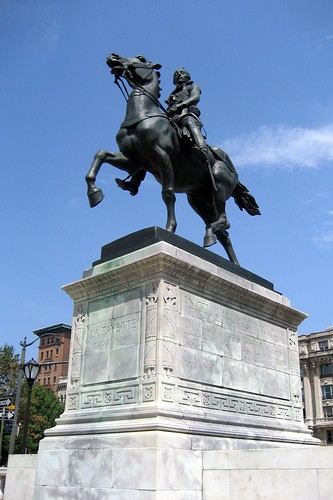

Baltimore - Mount Vernon: Lafayette  Monument

The “Farewell Tour” lasted fourteen months, in which time Lafayette visited all twenty-four states. He left for America on July 12, 1824 on an American merchant ship called The Cadmus. He arrived in New York on August 16. In each town/city he visited, a crowd of people waited to greet him. There was a lot of pomp and circumstance upon his arrival: festivities, banquets, banners, etc. Lafayette would give a speech and visit old friends in each place before moving to the next. Among the many cities Lafayette visited, in his above letter he specifically mentions Albany, Boston, Pittsburgh, Charleston, Savannah, and Camden.

In Charleston, South Carolina, Lafayette met up with his old and dear friend Colonel Francis Huger as he promised in his letter. Levasseur writes about welcome that both Huger and Lafayette received:

But of all these demonstrations of popular affection, what moved the General most was the touching and generous idea of the citizens of Charleston to have him share the honors of his triumph with his brave and excellent friend, Colonel Huger....When we entered Charleston, his fellow-citizens insisted that Huger take his place beside the Nation’s Guest in his triumphal carriage, where he shared with him the public’s felicitations and approbation. At the banquet, at the theatre, at the ball, everywhere in fact, Huger’s name was inscribed beside the name of Lafayette, to whom the inhabitants of Charleston did not believe they could express their gratitude better than by demonstrating equally deep gratitude to the one who had not been afraid to risk his life to set him free in the past.10


Upon his departure, Charleston’s city fathers gave Lafayette a gold-framed miniature of Huger. The miniature found a permanent home in La Grange, where it served as a constant reminder to Lafayette of his dear friend from South Carolina who risked his freedom trying to rescue him.11

*The Littlejohn Collection at Wofford College is home to three more letters written by the Marquis de Lafayette. The letters were written in 1801 and 1830.

- Hannah Jarrett ‘12 and Becky Heiser ‘11


1 Clary, David A., Adopted Son: Washington, Lafayette, and the Friendship that Saved the Revolution (New York: Bantam Books, 2007), p. 7-20.
2 Buckman, Peter, Lafayette (London: Paddington Press, 1977), p. 40.
3 Clary, p. 85-117
4 Clary, p. 115-117
5 Buckman, p. 143-144.
6 Spalding, Paul S., Lafayette: Prisoner of State (Columbia: University of South Carolina Press, 2010), p. 5-6.
7 Spalding, ch. 4-6.
8 Levasseur, Auguste, Lafayette in America in 1824 and 1825, Journal of a Voyage to the United States, trans. Alan R. Hoffman ( Manchester: Lafayette Press Inc., 2006) p. 2.
9 Levasseur, xxiv.
10 Levasseur, 315-316.
11 Spalding, 234-235.

7.20.2011

To Infinity and Beyond: The Men Behind the Moon Landing

On this date (July 20) in 1969 Neil Armstrong and Buzz Aldrin landed on the moon. Their accomplishment was enormous, but it came after decades of research, experiments, failures, and hopes. The first moon landing never would have succeeded without the work of many individuals including Robert H. Goddard, Charles A. Lindbergh, Harry Guggenheim, and others. We chose to emphasize the work of these men out of all those involved in the advancement of space exploration because we have some of their letters and autographs in the Littlejohn Collection at Wofford College.

Robert Hutchings Goddard (1882-1945) was one of the fathers of the science of astronautics and a pioneer in rocketry. He obtained a degree in physics at the Worcester Polytechnic Institute and received his PhD at Clark University in 1911. By 1913, his research in rocketry was underway, and he began receiving patents in 1914. Goddard believed, even this early, that it would be possible to land a person on the moon, an opinion he stated publicly in 1915. Funding for his research came from a number of sources, including the Smithsonian Institute and Clark University; however, in the 1920s and 1930s, funding was unpredictable, limiting his research. He received public notice in 1920 due to his statements claiming that his rocket technology would help rockets reach the “upper air regions” and one day even reach the moon.1 Unlike his German counterparts Hermann Oberth and Wernher von Braun, who were doing similar research in rocketry, Goddard deliberately designed his experiments to lay the groundworkspecifically for sending rockets to the moon.2

In the 1954 letter to Goddard’s wife Esther, Charles Lindbergh references Goddard’s July 17, 1929 test, which eventually brought Lindbergh, Guggenheim, and Goddard together. [Image of item removed for copyright reasons. The item may be viewed in person at the Wofford College Library. -Ed./Archivist]

After an unsuccessful test launch of his 11-foot, 35-pound rocket on May 17, 1929, Goddard tweaked his design and was ready for another test launch on July 17. The crew stood behind a wooden shelter, and Goddard pulled the cord to launch the rocket. Goddard did not hear the noise from the motor change, and, thinking that something was jammed, he was distracted and did not see the rocket launch. Luckily, Esther was recording the event with a Kodak camera. With a loud roar (that led one woman two miles away to believe there had been a plane crash) the rocket emitted a 20-foot exhaust flame. The rocket rose 80 feet in 19 seconds before returning to earth. The rocket suffered some damage due to the crash (the parachutes malfunctioned), but overall it was a successful launch. The noise attracted residents, two ambulances, and the media from miles away. In the following days, Goddard was in the headlines of local Worcester newspapers.3 Though he had the reputation of secretive “lonewolf,” he issued the following statement to the New York Times on July 18, 1929:


“The test this afternoon was one of a long series of experiments with rockets using entirely new propellants. There was no attempt to reach the moon, or anything of such a spectacular nature. The rocket is normally noisy, possibly enough to attract considerable attention. The test was thoroughly satisfactory; nothing exploded in the air, and there was no damage except incident to landing.”4

Watch video footage of Goddard’s experiments:

The publicity that resulted from the July 17 launch won Goddard many supporters, including Harry Guggenheim (1890-1971) and Charles A. Lindbergh (1902-1974). Goddard came to their attention whenCarol Guggenheim, Harry’s wife, gave Lindbergh a newspaper article about Goddard and his experiments. Actually, Goddard had applied for a Guggenheim Fund grant before, but was rejected as a rocketry “nut.” Lindbergh visited Goddard in November 1929. Lindbergh became interested in rocketry earlier that year and adamantly promoted a research program in rocketry. Like Goddard, Lindbergh dreamed of sending a rocket to the moon. He presented his ideas about rocketry to the DuPont corporation, suggesting that they attach a rocket to a plane to give it more take-off power. DuPont rejected his ideas, saying his dreams were impossible.5

Lindbergh did not give up on rocketry, though. When he visited Goddard on his Massachusetts farm, they discussed the possibility of reaching the moon. Lindbergh arranged for Goddard to meet with DuPont, but the company remained unimpressed. Instead, Goddard got a $5,000 grant from the Carnegie Institution, and in 1930 he received a four-year grant from Guggenheim for $25,000/year. Lindbergh continued to lobby on Goddard’s behalf until as late as 1939, working to gain the support of National Geographic and the U.S. Navy.6

Although Goddard did not live to see the 1969 moon landing, Lindbergh and Guggenheim remained interested in the project, as seen in their correspondence with Mrs. Goddard. Their dreams began to be realized in 1961 when President John F. Kennedy announced to the U.S. Congress that the United States of America would be the first nation to land a man on the moon. He set a deadline for the end of the decade and encouraged all Americans to support the effort. The president recognized the work of Goddard in his speech by stating that the technology would require alternate liquid and solid fuel boosters, which was Goddard’s greatest contribution to the science of rocketry. With this speech, the space race had begun.


[Image of item depicting Buzz Aldrin in space suit removed for copyright reasons. The item may be viewed in person at the Wofford College Library. -Ed./Archivist]

On July 20, 1969, 500 million people watched on television as Neil Armstrong (1930- ) and Buzz Aldrin (1930- ) became the first humans to step on the surface of the moon. Armstrong and Aldrin, and their co-astronaut Michael Collins (1930- ), represented the best of NASA’s astronauts. Both Armstrong and Aldrin had previous experience in the military and as pilots. They were disciplined and devoted to the mission of Apollo 11. When Armstrong stepped out of the lunar module, his pride in America’s accomplishment was clear in his famous words, “That’s one small step for man … one giant leap for mankind.” Aldrin followed shortly after and the two men spent two and a half hours exploring the surface of the moon, collecting samples of the dirt and rocks, and planting an American flag with a plaque that read, “Here men from the planet Earth first set foot upon the Moon. We came in peace for all mankind.”7

In this message broadcast from space, Armstrong referenced the importance of the work and dedication of Goddard and other pioneers of rocketry, as well as the support of the American people:


The responsibility for this flight lies first with history and with the giants of science who have preceded this effort. Next, with the American people, who have, through their will, indicated their desire. Next, to four administrations and their Congresses for implementing that will; and then to the agency and industry teams that built our spacecraft....To those people, tonight, we give a special thank you, and to all the other people that are listening and watching tonight, God bless you. Good night from Apollo 11.

[Image of item removed for copyright reasons. The item may be viewed in person at the Wofford College Library. -Ed./Archivist.]

When the Apollo 11 crew returned to Earth, they were given a hero’s welcome with parades, awards, and TV and radio appearances. Even today children recognize the importance of space travel, as a favorite movie character,
Buzz Lightyear, honors the name Buzz Aldrin. On a more serious note, the samples Aldrin and Armstrong collected were essential to the current scientific understanding of the moon. “The landing remains a symbol of American greatness, and images of it remain fixtures of numerous historical retrospectives. NASA, for all its accomplishments, is still best remembered as the agency that put a man on the Moon.”8

Watch NASA footage from the Apollo 11 Mission to the Moon:


On July 8, 2011, NASA launched its last shuttle into space. The shuttle, Atlantis, carried a crew of four on a 12-day mission to resupply the space station. Atlantis marks the end of the program that Goddard dreamed of and worked toward for so many years.

Watch footage of the final Atlantis launch:


- Becky Heiser ‘11 and Hannah Jarrett ‘12

1 New York Times, “Believes Rocket Can Reach the Moon: Smithsonian Institute Tells of Prof. Goddard’s Invention to Explore Upper Air. Multiple-Charge System Instruments Could Go Up 200 Miles, and Bigger Rocket Might Land on Satelite,” January 12, 1920.

2 McDougall, Walter A. ...The Heavens and the Earth: A Political History of the Space Age. New York: Basic Books, Inc., Publishers, 1985, p. 77.

3 Clary, David A. Rocket Man: Robert H. Goddard and the Birth of the Space Age. New York: Hyperion, 2003, p. 133-135.

4 New York Times, “Meteor-Like Rocket Startles Worcester; Clark Professor’s Test of New Propellant to Explore Air Strata Brings Police to Scene,” July 18, 1929.

5 Milton, Joyce. Loss of Eden: A Biography of Charles and Anne Morrow Lindbergh. New York: HarperCollins Publishers, 1993, p. 184-185.

6 Ibid.

7 "The 1969 Moon Landing: First Humans to Walk on Another World." Science and Its Times. Ed. Neil Schlager and Josh Lauer. Vol. 7. Detroit: Gale, 2009. Gale U.S. History In Context. Web. 29 June 2011.

8 Ibid.

7.06.2011

¡Feliz Cumpleaños Frida Kahlo!

Frida Kahlo was born on July 6, 1907, to Guillermo Kahlo and Matilde Calderon. Guillermo was a well-known photographer, and the family was moderately wealthy; however, Frida would have a difficult and pain-filled life. She contracted polio at age eleven which crippled her right leg and left her with a life-long limp. At age eighteen, Kahlo was in a terrible crash between a local bus and a trolley. She broke her leg, spine, collarbone, and pelvis in the accident and was forced to spend months wrapped in casts and bedridden in hospitals and at her home. Before her accident Kahlo studied medicine at the Escuela Nacional Preparatoria (National Preparatory School) in Mexico City. While she was bedridden, Kahlo was able to devote large amounts of time to painting, and it was during this time that she painted several of her first self-portraits that she would later show to Diego Rivera. After asking Rivera to critique her work, the two fell in love and got married in 1929.1

Diego Rivera was a huge man both in stature and in importance. He stood over six feet tall and never weighed less than 300 lbs in his entire adult life. He was charismatic, passionate, innovative, and determined. “He not only achieved his goal of bringing art to the people of Mexico, but also brought the art of Mexico to the world.”2His art represented Mexico’s contribution to modern art. Rivera’s style was grand in scale and ideology and his murals portrayed scenes designed to inspire nationalistic and socialistic sentiments in the viewer. The most common themes involve the roles of indigenous groups in the history of Mexico and those of the worker in the development of the nation.3

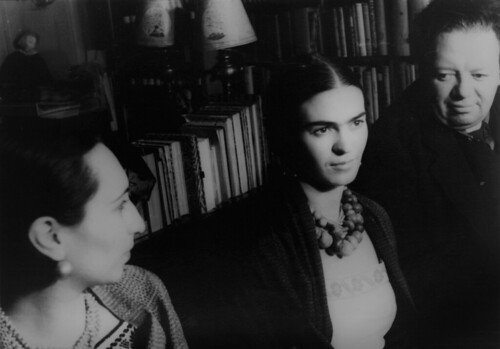
Frida Kahlo de Rivera, Diego Rivera and Malú Block by Carl Van Vechten, 1932

Malu Block, Frida Kahlo, and Diego Rivera.

The pair resided in the United States from 1930 through 1933 so that Rivera could work on the commissions he received from various American businessmen and politicians. During those three years Rivera worked on a number of projects including murals in San Francisco, Detroit, and Manhattan. He was eventually fired from working on a mural in the new Rockefeller Center because he painted a portrait of Vladimir Lenin in the middle of the mural - a less than desirable choice in Cold War America. Rivera and Kahlo returned to Mexico, and Rivera finished his murals in the Palacio Nacional (National Palace) in Mexico City and in the Hotel del Prado, the home of one of his best-known works: “Dream of a Sunday Afternoon in Alameda Park.”4

(For more Rivera paintings, click here.)

The Rivera-Kahlo marriage was a stormy one and was marked by infidelity on both sides. They divorced in 1939; however, by 1940, they remarried and remained married until Kahlo’s death in 1954. Kahlo was never able to have children, probably due to the accident during her teenage years, and she spent a lot of time in and out of hospitals, undergoing multiple surgeries for her chronic pain. Before she died, her right leg was amputated because of gangrene. Kahlo died on July 13, 1954, of either a blood clot or an intentional drug overdose.5

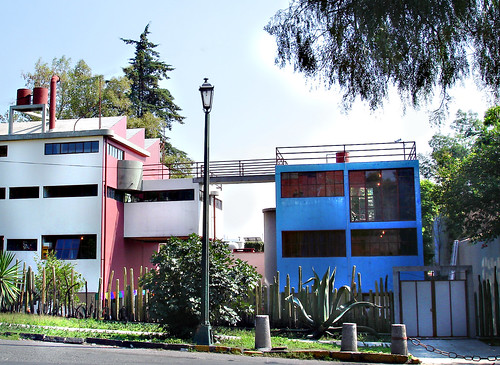
Casa de Diego Rivera y Frida

One of the houses where Rivera and Kahlo lived.

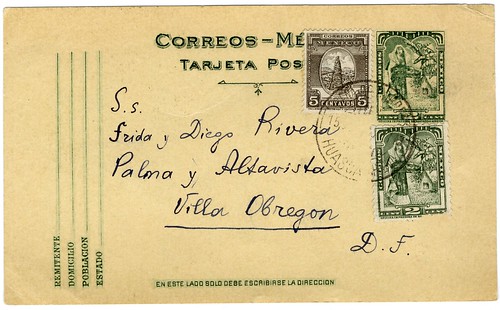
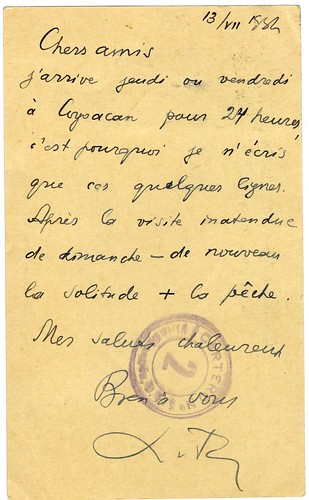
Throughout their lives Rivera and Kahlo were supporters and members of the Mexican Communist Party. They were vocal in their support, and both frequently used communist themes in their artwork. Their participation in the Communist Party created an opportunity for them to meet and house Leon Trotsky while he was in exile in Mexico City. When Joseph Stalin came to power in the Soviet Union, Trotsky fell quickly out of favor. He was exiled to Alma-Ata in Central Asia, but he escaped and fled to Turkey, then France, followed by Norway, and then eventually he found himself in Mexico in 1937. He had been invited to come to Mexico by the President Lazaro Cardenas and was welcomed by Diego Rivera and Frida Kahlo to Casa Azul, their home in Coyoacan, a province of Mexico City. Both Rivera and Kahlo were honored to have Trotsky stay with them, and they offered him and his family every protection they could provide. During his stay at the Kahlo home, Trotsky and Kahlo even had a love affair.6 His affair created tension within his own marriage, and he decided that he needed to get away from Kahlo and Rivera for a time. He went on a vacation to the countryside in July 1937. Frida made an unexpected trip to visit him; however, Trotsky refused to continue their affair. After this encounter he sent the following note addressed to Frida and Diego on July 13, 1937, which can be found in the Littlejohn Collection at Wofford College:

Postcard from Leon Trotsky to Frida Kahlo, Diego Rivera, 1937 (recto)

[translation and transcription]

I will arrive in Coyoacan Thursday or Friday for 24 hours; that is why I’m writing only a few lines. After Sunday’s unexpected visit - again solitude and fishing. My warm greetings.


Postcard from Leon Trotsky to Frida Kahlo, Diego Rivera, 1937 (verso)

Troksky lived in Mexico peacefully for some time. He had a fallout with Rivera in 1939 due to political differences, and he decided to move his family into a different house, although he remained in Coyoacan. Trotsky’s life was always in some danger, however, and there was an attempted assassination on May 24, 1940, when David Alfaro Siquieros fired over 200 shots into Trotsky’s home. The family escaped harm in that attack, but a second attempt proved successful. Ramon Mercader, a member of the Soviet secret police, broke into Trotsky’s home in Coyoacan and attacked him with an icepick on August 21, 1940.

“Mexican, shaped by disabilities, bisexual, inexhaustibly creative - all these ideas describe Frida Kahlo, but neither separately nor even together do they suffice to capture her spirit.”7 Frida’s personality is reflected in her artwork. Most of her paintings are autobiographical and followed the style called “mexicanidad.” This style rejected Western and aristocratic influences and instead focused on national folk culture. Accordingly she depicts herself in the traditional garb of the indigenous people of Tehuantepec using bright colors and a sense of fantasy. Kahlo described her work as “acid and tender, hard as steel, and delicate and fine as a butterfly’s wing, loveable as a beautiful smile, and profound and cruel as the bitterness of life.”8 Her artwork was popular around the world, and she had art shows in New York and in Paris. She only had one exhibition in Mexico shortly before she died. During her life, she was overshadowed by her husband, but her fame has only grown since her death, and now she is viewed by many as a feminist heroine.9

(For more Kahlo paintings, click here.)

Since the release of the 2002 film Frida, interest in Kahlo has revived. Her paintings have sold for millions of dollars. Madonna, the pop star, actually owns several originals. Some enthusiasts have begun to wonder if the image of Frida that is so appealing is in fact inaccurate, and the surge in interest and in biographies and other works has only served to further distort the image of the artist. Stephanie Mencimer, the editor of the Washington Monthly, argues that while most of Frida’s self-portraits portray her as a victim who could not have children and who was married to an unfaithful husband, the reality was that she never wanted children and she had her own extramarital affairs on a regular basis. Mencimer even goes so far as to say that many of Kahlo’s surgeries were unnecessary and were used to gain the attention of her husband and her acquaintances. Kahlo was not the Trotsky-supporter she seems to be in her biographies. In fact, Mencimer points out that after Trotsky’s assassination, Kahlo became a devout Stalinist.10 It is difficult to say whether Mencimer’s view of Kahlo or the artist-as-victim view is more accurate. Much of Kahlo’s life story has been constructed around her paintings, and Mencimer challenges the validity of this approach. Perhaps more evidence is needed to construct a well-rounded picture of Kahlo. Recently, Carlos and Leticia Noyola of San Miguel de Allende, Mexico, announced in 2010 that they have a collection of Frida possessions: paintings, letters, diaries, clothing, and knick-knacks. The initial reaction of Kahlo experts was to declare the collection forgeries; however, a year later, the debate over the authentication of these items is still in full swing with little progress on either side.11 But perhaps the recently-discovered collection is exactly what is needed and can provide a new, more accurate glimpse into the life of Frida Kahlo.

- Becky Heiser ‘11


1 Tibol, Raquel. Frida Kahlo: An Open Life, trans. Elinor Randall. Albuquerque: University of New Mexico Press, 1993.

2 “Diego Rivera,” Contemporary Hispanic Biography, Vol. 2, Gale, 2002, Gale World History in Context, 23 June 2011.

3 "Rivera, Diego," The Oxford Dictionary of Art and Artists. Ed Ian Chilvers. Oxford University Press 2009 Oxford Reference Online. Oxford University Press. 27 June 2011 .

4 "Diego Rivera," Contemporary Hispanic Biography. As above.

5 "Frida Kahlo," Contemporary Hispanic Biography. Vol. 1. Gale, 2002. Gale World History In Context. 23 June 2011.

6 "Kahlo, Frida," The Oxford Dictionary of Art, Ed. Ian Chilvers, Oxford University Press, 2004, Oxford Reference Online, 23 June 2011, .

7 "Frida Kahlo," Contemporary Hispanic Biography. As above.

8 “Kahlo, Frida" A Dictionary of Modern and Contemporary Art, Eds. Ian Chilvers and John Glaves-Smith. Oxford University Press, 2009, Oxford Reference Online, 5 July 2011.

9 Ibid.

10 Mencimer, Stephanie, “The Trouble with Frida Kahlo: Uncomfortable truths about this season’s hottest female artist,” The Washington Monthly, June 2002, http://www.washingtonmonthly.com/features/2001/0206.mencimer.html#byline, June 29, 2011.

11 Yabroff, Jennie, “The Frida Fighters,” Newsweek, August 26, 2010, http://www.newsweek.com/2010/08/26/the-case-of-the-questionable-frida-kahlo-paintings.html, June 29, 2011.